Principals of Pelli Clarke Pelli Choose Chadsworth

WHO CHOOSES CHADSWORTH COLUMNS FOR THEIR OWN HOME?

Restoration of Architects’ Home
By Principals at
Pelli Clarke Pelli Architects
New Haven, CT


*Designers of the world’s most recognizable buildings


From the World Financial Center in New York to the Petronas Towers in Malaysia and the International Finance Centre in Hong Kong, Pelli Clarke Pelli has had the great fortune to design many prestigious projects.  Our portfolio includes retail and mixed-use projects, academic buildings, libraries, museums, research centers, residences and master plans, and we have served private clients, businesses, institutions and government agencies.  Our work has received critical acclaim and hundreds of design awards, including the American Institute of Architects’ Firm Award, the highest honor for an architectural practice.  In 1995, the American Institute of Architects awarded Cesar Pelli the Gold Medal, its highest honor for an individual.  In 2004, the firm was given the Aga Khan Award for Architecture for the Petronas Towers.


For the past six years, two principals at PCPA have been doing a painstaking and loving restoration of their New Haven home, culminating in significant exterior work executed during the past year.  Chadsworth made a significant contribution to that effort.


The copy above was sourced from pcparch.com


BEFORE PICTURE

BEFORE PICTURE

BEFORE PICTURE

BEFORE PICTURE

BEFORE PICTURE

BEFORE PICTURE

AFTER PICTURE

AFTER PICTURE

AFTER PICTURE

AFTER PICTURE


Photos courtesy of:  Robert Narracci | Pelli Clarke Pelli Architects.

 
Moritz Spier House
Location:  New Haven, Connecticut
Year Built:  1895
Architects:  Brown & Von Beren
Style:  Georgian Revival


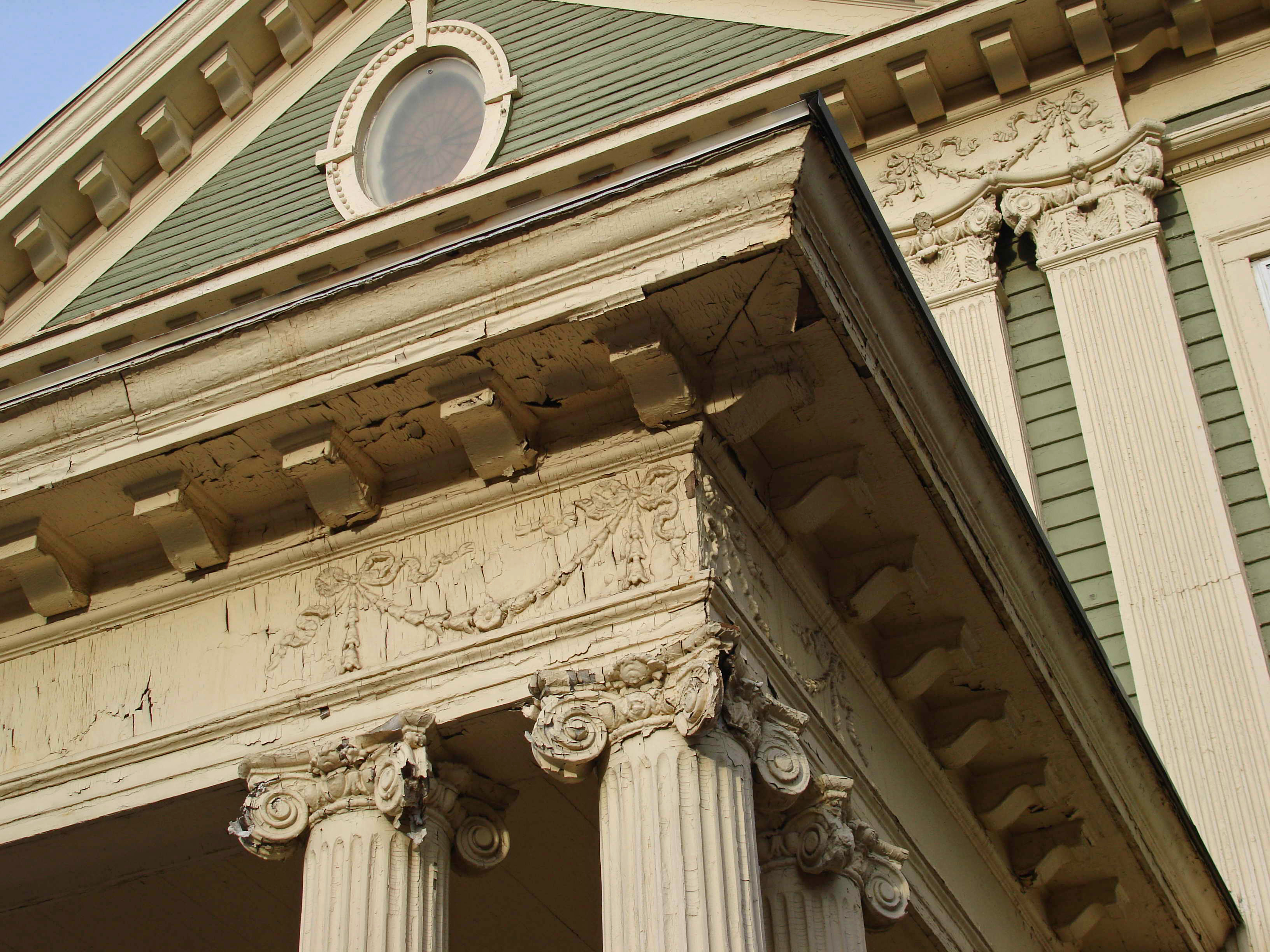
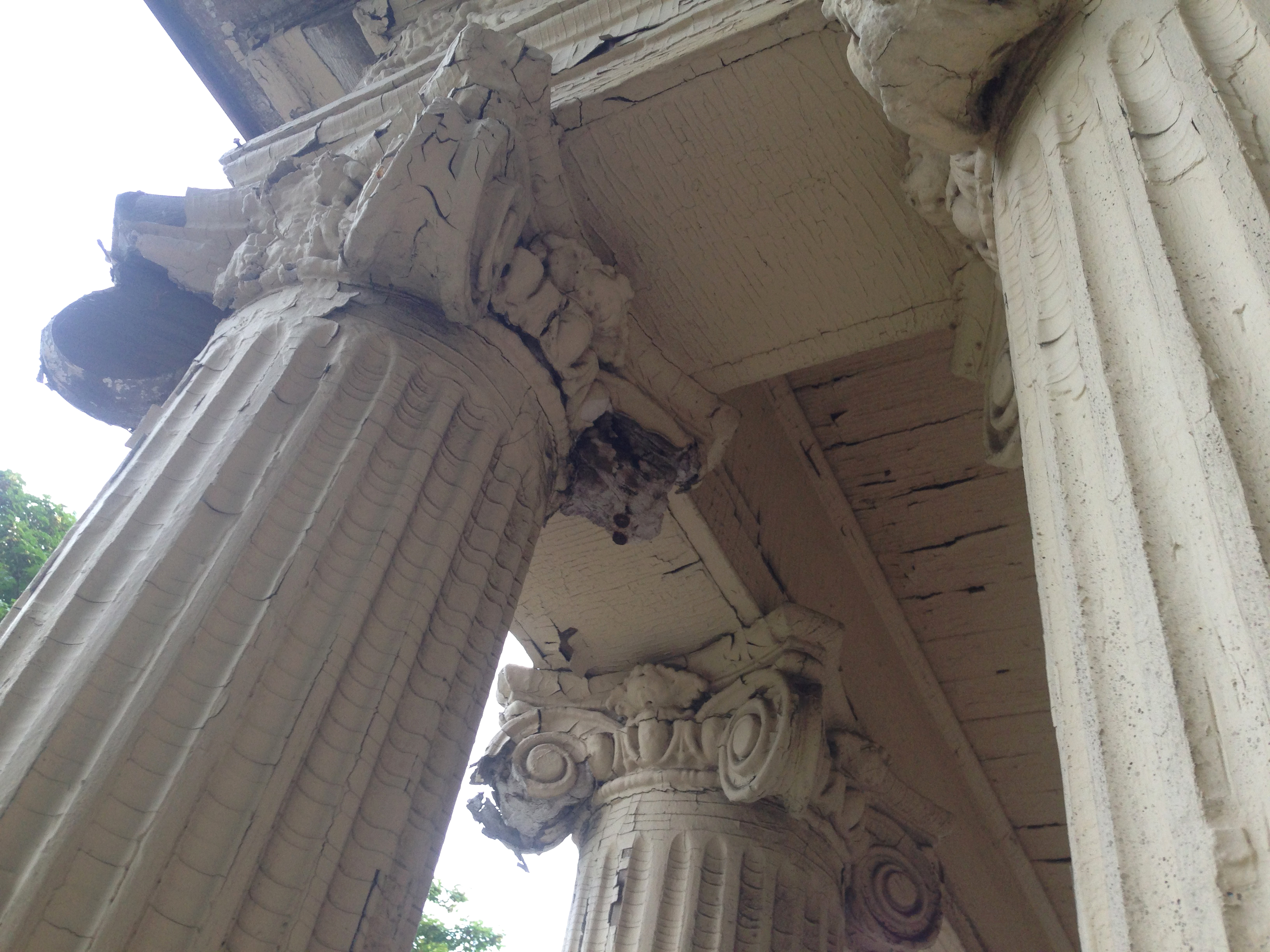
Consulting with Chadsworth, the architects chose a Scamozzi column capital, which was nearly an exact replica of the severely damaged originals at the main entrance.  Like much of the house, which had been neglected for many decades, the original capitals ultimately proved to be held together by 115 years of paint.  The capitals are a key feature of a strongly symmetrical façade, and the architects were grateful to remain true to the original design intent.  Brown & Von Beren Architects were very active in New Haven, and this house represents a late and rare example of very strict Georgian revival done in the East Rock neighborhood.  The original house owner, Moritz Spier, was a warm-hearted coal merchant known to have carried the accounts of hundreds of families through the many economic downturns of that period.  The house had few owners, and its highly detailed interior woodwork has thankfully remained unpainted.  Because of its large foyer and wide open central staircase, the geometry of the house helped it survive a trend of partitioning large houses into Yale graduate student apartments.  The current owners are pleased to bring this grand structure back to life.

For more information about the principal architects and the firm of Pelli Clarke Pelli Architects, please visit their web site at:

www.pcparch.com


Visit our online store at:

Classical Comments: The Diocletian Window (By Calder Loth – ICAA)

calder-loth-imgBy Calder Loth
Senior Architectural Historian for the Virginia Department of Historic Resources and a member of the
Institute of Classical Classical Architecture & Art‘s Advisory Council.

Courtesy of: the Institute of Classical Architecture & Art  blog.classicist.org/

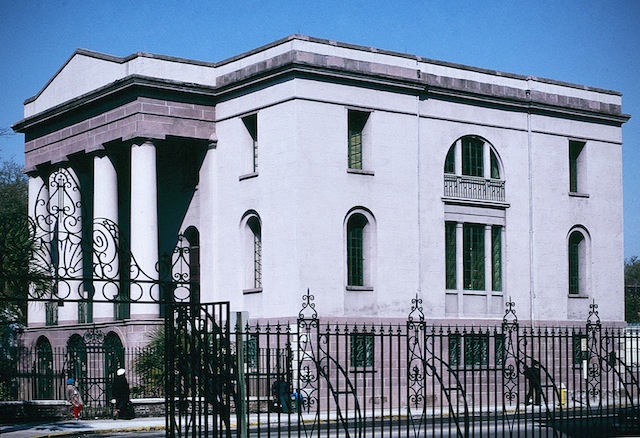
Dedicated in 306 A.D., the Baths of Diocletian survive as Rome’s only relatively intact ancient bath structure. Its main space, the vast vaulted frigidarium,[i] was preserved by conversion to a church under the direction of Michelangelo in 1563-64.[ii] A distinctive feature of the frigidarium is the series of huge windows along the upper tier of its side walls. (Figure 1) The window form consists of a large semi-circular arch divided into three sections by two thick vertical mullions.[iii] Because of their association with this structure, windows in this configuration are termed Diocletian windows, but we also describe them as thermal windows from thermae, the Latin word for warm bath. The windows’ brick construction was originally veneered with stone moldings and decorations of which only fragments remain in situ. Nevertheless, the form appealed to Renaissance architects who popularized it through treatises and projects. As we see in the following survey, architects have interpreted and applied the Diocletian window in a variety of ways over the past four and a half centuries.

Figure-17

Figure 1. The Baths of Diocletian, Rome (Loth)

Figure-21

Figure 2. Villa Foscari, Italy (Loth)

Andrea Palladio undertook detailed studies of Roman bath ruins with the intention of producing a book on the subject. His project never materialized but various features observed in the ruins found their way into several of Palladio’s designs.[iv] The Diocletian window appears in three of Palladio’s villa elevations published in Book II of I Quattro Libri (1570). Perhaps Palladio’s most prominent Diocletian window dominates the rear elevation of the ca. 1560 Villa Foscari, also known as La Malcontenta. (Figure 2) We have no published drawing of the rear; Palladio’s treatise illustrates only the villa’s portioced façade. Nevertheless, like the ancient prototype, the villa’s huge window is reduced to essentials. Its only ornament is the rustication joints scribed into the stucco.

Figure-31

Figure 3. San Moisè, Venice (Loth)

Palladio set a precedent for incorporating a Diocletian window into the façades of Venetian churches with his designs for San Francesco della Vigna (1566-70) and S. Maria della Presentazione, also known as Le Zitelle, (1577-80).  Palladio also incorporated Diocletian windows in the clerestory of Il Redentore (consecrated 1592). The tradition extended to several later Venetian churches including the façade added in 1688 by Alessandro Tremignon to the church of San Moisè, perhaps the most luscious Baroque façade in Venice. (Figure 3) Though hardly small, the Diocletian window above the entrance is almost overwhelmed by its Baroque encrustations. The window itself is set well back from the heavily decorated arch and mullions. With its sculptures by Heinrich Meyring, the façade is a monument to the Fini family, its patrons.

Figure-41

Figure 4. Gibbs Building, King’s College Cambridge: James Gibbs, A Book of Architecture (1728), plate 34.

In 1724, architect James Gibbs received the commission to design a complex of buildings for the front court of King’s College, Cambridge. Of the three massive structures in Gibbs’s scheme only the West Range, built 1724-31, was realized. For the central pavilions of each front, Gibbs proposed a broad Diocletian window atop a Doric aedicule framing the entrance arch. (Figure 4) This composition closely followed Palladio’s final design for the Villa Pisani at Bagnolo shown in Book II of I Quattro Libri.[v] As illustrated in Gibbs’s A Book of Architecture (1728), Gibbs intended the pediment slopes of the King’s building to be adorned with statues of reclining scholars in the manner of the figures on Michelangelo’s Medici tombs. The sculptures were never realized. Gibbs proposed a similar combination Diocletian window and portico for Whitton Place, Middlesex, but his design was rejected in favor of a design by Roger Morris.[vi]

Figure-51

Figure 5. Chiswick, London (Loth)

Richard Boyle, 3rd Earl of Burlington, was the primary leader of England’s 18th-century Anglo-Palladian movement. His passion for the architecture of Andrea Palladio and his contemporaries inspired his design for his villa at Chiswick. (Figure 5) Completed in 1729, the compact structure exhibited in its forms and details Lord Burlington’s broad knowledge of Palladian architecture. Burlington crowned his house with an octagonal dome prominently fitted with Diocletian windows on its four main faces. The use of this motif was likely inspired by one of Palladio’s early schemes for the Villa Pisani at Bagnolo, the drawing for which was among Burlington’s large collection of original Palladian drawings. (Figure 6) The stair and inset Palladian window in the drawing are features also reflected in Chiswick.

Figure-61

Figure 6. Andrea Palladio, Preliminary design for the Villa Pisani at Bagnolo; pen and brown ink drawing, ca. 1542. (Royal Institute of British Architects)

Figure-71

Figure 7. Mount Clare, Baltimore (Loth)

The lunette in the pediment of Baltimore’s Mount Clare is among America’s very rare Colonial-era versions of the Diocletian window. (Figure 7) Unlike the more standard half-circle examples, Mount Clare’s window is a shallow segment supported with the requisite pair of vertical mullions to give it the thermal form. The voids between the mullions are backed with small window panes. Mount Clare was erected in 1760 as a villa with an extensive park and terraced garden for Charles Carroll, a prominent Maryland patriot. As seen in the illustration, the house walls are laid in header bond, a characteristic feature of the finest colonial Maryland dwellings.

Figure-81

Figure 8. Faneuil Hall, Boston (Loth)

The Diocletian window enjoyed increased though limited popularity during the Early Republic. Boston architect Charles Bulfinch installed them in a handful of his buildings, including his 1805 expansion of the 1742 Faneuil Hall in the heart of Boston. (Figure 8) Bulfinch’s remodeling  involved increasing the original three-bay façade to seven bays and adding the tall third story. To accent the resulting vast pediment, Bulfinch inserted a Diocletian window flanked by two circular windows. Bulfinch gave prominence to the somewhat diminutive Diocletian window by framing it in a broad curved architrave, a trick he used in other designs and one that works effectively in this prodigious structure.

Figure-91

Figure 9. Former Bourse, St. Petersburg, Russia (Loth)

Architect Thomas de Thomon used the Diocletian window with dramatic flair in the attic gable of the St. Petersburg Bourse (Stock Exchange), a monumental landmark on the prow of Vlasilyevsky’s Island, across the Neva from the Winter Palace. (Figure 9) A multiplicity of thin voussoirs forming the arch gives the window the effect of a radiant sun rising from the portico. Partly hiding it, however, is S. Sukhanov’s sculpture group of Neptune with Two Rivers.  Surrounding the building is a peristyle of forty-two unfluted Greek Doric columns, an echo of Paestum. The strategically sited structure served as the center of financial and trade operations for Imperial Russia. Since 1940, the building has housed the Central Naval Museum.

Figure-101

Figure 10. Imperial Stables and Carriage House, Pushkin, Russia (Loth)

We see a more lighthearted use of Diocletian windows on the Imperial stables in Pushkin (formerly Tsarskoye Selo), the suburban town of palaces and parks south of St. Petersburg. (Figure 10) Rendered in Russia’s virile Neoclassical style, the 1820 stable complex was designed by Vasily Stasov and Smaragd Shustov. Here a series of windows punctuates the façade of the stable courtyard. Setting off each window is a thick, plain lintel painted white to contrast with the tan stucco. The curved lintels reflect the semi-circular plan of the courtyard. The battered doorway and keystone focus attention on the center window. Vasily Stasov is best known as the architect of the Winter Palace staterooms, rebuilt after the fire of 1837.

Figure-111

Figure 11. Fireproof Building, Charleston, South Carolina (Loth)

Architect Robert Mills incorporated a Diocletian window in the Meeting Street elevation of the Fireproof Building, constructed 1820-27 as a state office building. (Figure 11) It quickly became known as the Fireproof Building because of its pioneering use of non-combustible materials to protect government records. Though he was a dedicated classicist, Mills used the Diocletian motif in only a few instances. His mentor, Thomas Jefferson, interestingly, applied the motif to none his buildings. In the Fireproof Building, Mills tied the window into a composition embracing the three-part window below. Accenting it is a decorative iron railing, giving a lightness to an otherwise visually solid structure.

Figure-121

Figure 12. Low Memorial Library, Columbia University, New York City (Loth)

The firm of McKim, Mead & White made use of the Diocletian window in a variety of forms in numerous projects. In two of the firm’s most monumental works: Pennsylvania Station (1906-10; demolished 1964) and Columbia University’s Low Memorial Library (1893-95), the widows were of such huge scale that they were divided by four vertical mullions rather than the more standard two. (Figure 12) The use of four mullions at Low Library may have been dictated by the fact that the mullions are metal rather than thick masonry.  Nevertheless, with the window panes set in Roman lattice, the broad composition has a gracefulness despite its size.

Figure-131

Figure 13. Bavarian State Chancellery, Munich, Germany (Loth)

The heavy classicism of Imperial Germany, known as the Wilhelmine style, is boldly exhibited in the central domed section of what is now the Bavarian State Chancellery in Munich. (Figure 13) At the base of the dome is a pedimented pavilion framing a rusticated Diocletian window, a weighty contrast to the window in the Natural History Museum shown below. Designed by Ludwig Mellinger, the building’s center section is all that remained of the 1905 Bavarian Army Museum following the Allied bombing in World War II.  The destroyed wings were rebuilt in 1992 in glassy greenhouse style to house the state legislature and government offices.

Figure-141

Figure 14. Museum of Natural History, Washington, D.C. (Loth)

The firm of Hornblower and Marshall provided our National Mall with a classic Diocletian window set in the open tympanum pediment of the Natural History Museum, built 1901-11. (Figure 14) The allusion to classical Antiquity is reinforced by the use of bronze Roman lattice in the openings. Executed in white granite, the window’s plain architrave frame and vertical mullions lend the composition a restrained monumentality. Below the window is a hexastyle colonnade employing the Corinthian order of the Temple of Castor and Pollux, the three columns of which survive in the Roman Forum. The museum’s pediment and window is one of four identically treated pediments providing buttressing for the dome of this monument of the American Renaissance.

Figure-151

Figure 15. Memorial Gymnasium, University of Virginia, Charlottesville (Loth)

The ancient Roman baths provided excellent precedents for enormous formal enclosures such as railroad stations and gymnasiums. We see this in the University of Virginia’s Memorial Gymnasium, whose form was inspired by the Baths of Diocletian. (Figure 15) Completed in 1924, the design was the product of an architectural commission with Fiske Kimball, founder of the university’s school of architecture, serving as supervising architect. As with the Diocletian bath’s frigidarium, Memorial Gymnasium’s side elevations are composed of a series of gables supporting huge Diocletian windows. The gymnasium’s brick construction reflects the brick walls of the Roman baths, stripped of their stone veneers.

Figure-161

Figure 16. Brooks Brothers Store, Beverly Hills, California (Loth)

[i] The frigidarium was the main space in the bath complex. It was so termed because it contained a series of pools for cold baths.
[ii]
The church name is the Basilica of Santa Maria degli Angeli e dei Martiri. It was further embellished by architect Luigi Vanvitelli in 1749.
[iii]
The bottoms of the arches, where the curve meets the lintel, have been infilled with masonry for extra support, giving the arch a slightly stilted look.
[iv]
Palladio’s drawings of the baths were eventually published by Lord Burlington in 1730, and by Charles Cameron in 1772.
[v]
The portico proposed for the Villa Pisani was not built but the Diocletian window is intact.
[vi]
Terry Friedman, James Gibbs (Yale University Press, 1984), p. 317.

Classical Comments: Eustyle – By Calder Loth

Classical Comments:  Eustyle

By:  Calder Loth

Senior Architectural Historian for the Virginia Department of Historic Resources and a member of the Institute of Classical Architecture & Art’s Advisory Council.

Source:  http://blog.classicist.org/

Pantheon portico

Figure 1.  Pantheon portico, Rome; an ancient example of eustyle intercolumniation (Loth)


In The Ten Books on Architecture, the famous (and only surviving) ancient treatise on architecture, its author, Vitruvius, discusses how the character of a temple portico can be affected by the spacing of its columns.  Vitruvius defines closely spaced columns pycnostyle, which means the column shafts are spaced one and a half column diameters apart. This gives a portico a very static appearance. The widest spacing is araeostyle, which is four diameters apart. Vitruvius tells us araeostyle is impossible with masonry construction because the spans are too great for stone architraves. Areaostyle spacing is practical only when architraves are composed of wooden beams. Other types of intercolumniation are systyle (two diameters apart) and diastyle (three diameters apart). In all four spacing types, the columns have equal-width spaces between them.


Vitruvius then informs us that the ideal intercolumniation system is eustyle. As defined by Vitruvius, a eustyle portico has bays that are two and a quarter diameters in width except for the center bay, which is three diameters wide.  Vitruvius proclaimed the superior quality of eustyle spacing, stating, “In this way, the temple will have a beautiful configuration with no obstruction at the entrance.”[1] The term eustyle is derived from the Latin prefix eu, meaning good (as in euphoria—feeling good), and the Latin stilus, a narrow cylindrical object; i.e., a column shaft. The principle of eustyle spacing can be applied to porticos of four (tetrastyle), six (hexastyle), and eight (octastyle) or more columns.


Pantheon portico (detail)

Figure 2.  Pantheon portico (detail), ‘The Four Books’ (Isaac Ware edition, 1738) Book 4, plate LI


In perusing Book 4 of Andrea Palladio’s Quattro Libri (Four Books on Architecture), we might note that the majority of the ancient porticoed temples in Palladio’s reconstruction drawings incorporate some form of eustyle spacing.  Among them is the Pantheon, where Palladio notes that the portico’s center bay, in Vincentine feet and inches,[2] is  9’3½” wide, while the outer bays are 8’2½”wide. (Figure 2) Even though the temples Palladio measured and illustrated normally employ a slightly wider center bay, not all strictly follow Vitruvius’s spacing formula. Indeed, in some of the temple elevations, such as that for the Temple of Saturn, the dimension variation is so subtle that we need to look very carefully to see the effect. (Figure 3) Except for the Ionic temples of Portunus[3] and Saturn,[4] all of the porticoed temples Palladio included in Book 4 are in the Corinthian order, the preferred order for major buildings of the Roman imperial period.


Temple of Concord (Saturn)

Figure 3. Temple of Concord (Saturn), ‘The Four Books’ (Isaac Ware edition, 1738) Book 4, plate XCIII


Palladio employed some form of eustyle spacing in virtually all of his portioced villa and palace designs published in Book 2 of Quattro Libri. Because of the small scale of several of his villa elevations, as illustrated in the original woodcut prints, the eustyle spacing is not readily apparent. We see this in his elevation of the Villa Emo, where eustyle is not depicted. (Figure 4) However, as built, the villa subtly incorporates eustyle spacing in its Tuscan portico. (Figure 5) Palladio made no secret of his preference for eustyle intercolumniation. In Chapter IV of  Book 4 of Quattro Libri, Palladio paraphrased Vitruvius thusly: “So, then, the most beautiful and elegant sort of temple is called eustyle, which occurs when the intercolumniations are two and quarter column diameters, because it is extremely practical and also provides beauty and strength.”[5]


Villa Emo

Figure 4. Villa Emo, (detail), ‘Quattro Libri’ (Tavenor and Schofield translation of the 1570 edition), Book II p. 55


Figure 5. Villa Emo, Fanzolo, Italy (Loth)

Figure 5. Villa Emo, Fanzolo, Italy (Loth)


Among the aesthetic advantages of eustyle intercolumniation is the subliminal focusing of attention on a building’s entrance.  We see this in an almost subconscious way in each of the porticos of Palladio’s Villa Rotonda. (Figure 6) More importantly, making use of eustyle spacing can correct an optical illusion.  Consider, for example, the Tuscan portico of the 1826 Goochland County courthouse with its areaostyle (four diameters) column spacing. (Figure 7) Although the portico’s three bays are exactly the same width, the center bay appears narrower—an optical illusion. In contrast, the similar Tuscan portico on the 1823 Frascati makes use of eustyle intercolumniation. (Figure 8)  As with the Villa Emo, Frascati’s eustyle spacing lends a more visually pleasing character to the composition even though it is not immediately apparent that the center bay is wider, especially if not viewed straight on.


Figure 6. Villa Rotondo, Vicenza, Italy (Loth)

Figure 6. Villa Rotondo, Vicenza, Italy (Loth)


Goochland County Courthouse

Figure 7. Goochland County Courthouse, Goochland, Virginia (Loth)


Figure 8. Frascati, Orange County, Virginia (Loth)

Figure 8. Frascati, Orange County, Virginia (Loth)


Both the Goochland Courthouse and Frascati were designed and built by master builders who had worked for Thomas Jefferson at the University of Virginia. There they learned the classical language, but not necessarily a consistent use of eustyle spacing. Despite his strong advocacy of Palladian forms, Jefferson applied the eustyle principle only rarely. His Pavilion V at the University of Virginia is the only one of the institution’s ten pavilions to have eustyle spacing. (Figure 9) Here the hexastyle Ionic portico bears a strong resemblance to the porticoes of the Villa Rotonda, a work that was an important inspiration for Jefferson.  Jefferson headed his handwritten specification notes on the pavilion: “Pavilion No.V. Palladio’s Ionic modillion order.”[6] His awareness of eustyle is evident further down in the notes where he wrote: “from cent. to cent. of Columns mod 3 1/3 gives intercol. of mod. 2 1/3 the eustyle being 2 ¼ mod . . .”[7] Jefferson also used barely perceptible eustyle spacing in his proposed design for the residence of the United States President, a scheme based on the Villa Rotonda.


Pavilion V, University of Virginia (Loth)

Figure 9. Pavilion V, University of Virginia (Loth)


The 18th-century English Palladian architects were more consistent with their advocacy of Vitruvius’s and Palladio’s preference for eustyle spacing.  A majority of the portioced designs in Colen Campbell’s Vituvius Britannicus (1715 & 1725) have eustyle intercolumniation.  Sir William Chambers discussed some of the issues of eustyle in his Treatise on the Decorative Part of Civil Architecture. “It is however to be observed, that if the measures of Vitruvius be scrupulously adhered to, with regard to the eustyle interval, the modillions in the Corinthian and Composite cornices, and the dentils in the Ionic, will not come regularly over the middle of each column. The ancients, generally speaking, were indifferent about these little accuracies.” [8] Chambers went on to explain how to deal with the problem by making the column spacings slightly wider. Perhaps Campbell and Chambers were inspired by Inigo Jones, the patron saint of the Anglo-Palladian movement, who employed eustyle spacing conspicuously in the loggia on the Queen’s House, Greenwich (1616-35), a herald of English Palladianism. (Figure 10)


Queen’s House, Greenwich, England

Figure 10. Queen’s House, Greenwich, England, ‘Vituvius Britannicus’, Vol. 1, plate 15


The Anglo-Palladian architect, James Gibbs, on the other hand, was less concerned with eustyle design. He is silent on the subject in his otherwise highly influential Rules for Drawing the Several Parts of Architecture (1732). Moreover, nearly all of Gibbs’s portioced designs in A Book of Architecture (1728) lack eustyle spacing. Even his most famous work, St. Martin in the Fields (1722-26) avoids eustyle spacing, a design that influenced hundreds of American churches. (Figure 11) We might note, however, that in one of the most faithful adaptations of St. Martin, the 1924 All Souls Unitarian Church in Washington, D.C., architect Henry Shepley applied eustyle spacing in its Corinthian portico. (Figure 12)  Shepley may have been adhering to Chambers’ advice on how to handle the eustyle principle with the Corinthian order. More likely, he was following William R. Ware’s instructions in The American Vignola, the textbook for nearly every American architect of the first half of the 20th century. Ware wrote,


“The ancients . . . preferred what they called Eustyle Intercolumniation, of two and one-half Diameters (or three and one-half Diameters on centers, in place of three Diameters). But the moderns prefer to make the Eustyle Intercolumniation two and one-third Diameters (setting the columns three and one-third Diameters on centers), as this brings even Columns in Ionic and Corinthian colonnades exactly under the Dentil, and every alternate one just under a Modillion, the Dentils being one-sixth of a Diameter on centers, and Modillions two thirds of a Diameter.” [9]


If we look carefully at All Souls’ portico, we can see that each column is centered under a modillion.


St. Martin in the Fields

Figure 11. St. Martin in the Fields (detail), James Gibbs, ‘A Book of Architecture’, plate 3


All Souls Unitarian Church

Figure 12. All Souls Unitarian Church, Washington, D.C. (Loth)


Eustyle spacing is not so accommodating for the Doric order. If a column is to be properly centered beneath a triglyph, the middle bay cannot be widened without adding an extra triglyph, thus precluding any chance for a less pronounced increase in spacing in the center. We see this in comparing the porticos of Monticello (Figure 13) and the Redwood Library. (Figure 14) Monticello’s portico bays are the same width, but even here, the center bay appears narrower than the flanking bays. The entablature in the Redwood Library’s center bay employs the extra triglyph resulting in the center bay being conspicuously wider.


Monticello portico

Figure 13. Monticello portico (Loth)


Redwood Library, Newport, Rhode Island

Figure 14. Redwood Library, Newport, Rhode Island (Historic American Buildings Survey)


An awareness of the ancient principle of eustyle intercolumniation prompts us to take a more careful notice of the numerous porticoes we encounter. Many of the great landmarks of the American Renaissance employ eustyle spacing, including the Columbia University Library, the Lincoln Memorial, and the Supreme Court. John Russell Pope did not overlook the effectiveness of this age-old principle in what is perhaps the nation’s most prodigious Corinthian portico, on the National Archives. (Figure 15) Oftentimes the effect is so subtle that, like the Pantheon, it is more felt than seen.

National Archives

Figure 15. National Archives, Washington, D. C. (Loth)


[1] Thomas Gordon Smith, Vitruvius on Architecture, (The Monacelli Press , 2003) p. 96
[2]
Though various Renaissance texts vary, the Vincentine foot is approximately 13.5 inches imperial.
[3]
Called by Palladio the Temple of Fortuna Virilis.
[4]
Called by Palladio the Temple of Concord.
[5]
Andrea Palladio, The Four Books on Architecture, Translated by Robert Tavenor and Richard Schofield, (MIT Press, 1997) p. 219.
[6]
Mesick-Cohen-Waite Architects, Pavilion V, Historic Structure Report (University of Virginia, 1994) p. 20.
[7]
Ibid.
[8]
Sir William Chamber, A Treatise on the Decorative Part of Civil Architecture (2003 Dover Publications reprint of the London, 1791 third edition) p. 81.
[9]
William R. Ware, The American Vignola (1994 Dover Publications Reprint of the 1903 edition) p. 47.
Architectural Etymology: by Calder Loth


Classical Comments:  Architectural Etymology

Courtesy of the Classicist Blog:  http://blog.classicist.org/

by Calder Loth
Senior Architectural Historian for the Virginia Department of Historic Resources and a member of the Institute of Classical Architecture & Art’s Advisory Council.


The study of classical architecture introduces us to a multitude of terms for the various parts of the orders. For many it is a completely new vocabulary, one often difficult to learn. An investigation of the etymology of the words can be helpful for remembering many of the terms and understanding their rationale. As with so much specialized terminology, numerous objects received their names because they reminded people of familiar, similar-looking things. We see this happening in scores of different categories. For instance, we call the control device on an instrument panel a button. The glass vacuum vessel encasing an incandescent electric light is a bulb. The name given to the symbol for a program on a computer screen is an icon. (And don’t forget the mouse.) This naming phenomenon is particularly prevalent in classical architecture. For this month’s essay, I have taken terms for elements of the entablature and capital of the Tuscan order and explored why they are called what are and where their names came from. I hope this simple exposition will serve to foster a more informed appreciation of the classical language of architecture. I hope also to explore the etymology of additional classical features and details in future Classical Comments essays.

The image I have used for this investigation is a detail of the Tuscan order illustrated in Abraham Swan’s The British Architect (1758), which offers some of the most precise and beautiful depictions of the classical orders.

*  Denotes that the word is a term defined in the list.


The Beaux-Arts Atelier & ICA&CA Feature in the Wall Street Journal Online Source

The Wall Street Journal Online features the

Beaux-Arts Atelier and the ICA&CA!

This is a wonderful article about the Beaux-Arts Atelier and the Institute of Classical Architecture & Classical America.

Read the Article