‘Invoking an Ideal’ — Chadsworth Featured in Architectural Digest

Invoking an Ideal

Romanticized Forms Pay Homage to Southern Architectural Traditions in a Historic Landscape
 
Architecture by Ike Kligerman Barkley/Interior Design by Renée O’Leary
Text by Joseph Giovannini/Photography by Durston Saylor
Published June 2008
In some circles, having multiple personalities may be viewed as a psychological disorder, but in architecture, it can be a good thing.


When the New York firm Ike Kligerman Barkley was commissioned to design a house in the Virginia horse country, several considerations pulled the architects in complex and contradictory directions. Thomas Jefferson, Monticello and the Palladian tradition of plantation houses still weigh heavily on the collective architectural psyche. Yet in the more specific context of the Green Springs Historic District, a protected agricultural landscape, most buildings are modest farmhouses. While the house had to hold its own on a 1,000-acre site within the historic-land trust, it couldn’t overwhelm empty nesters who were retiring from New York to live in a landscape they had no intention of dominating. “We wanted something that would fit in with the area,” says Renée O’Leary, the client, a professional designer who did the interiors. She and her husband had worked previously with the architects on their home in Connecticut (see Architectural Digest, August 1999). 


The land, then, with rolling hills, pasturage, native cedars and a 10-acre lake, looked innocent—and large enough to handle just about anything—but it was actually a multivalent site charged with conflicting expectations. Fitting it into a context polarized between manor and farmhouse meant multiplying its architectural personality. The big house had to be small, underbuilt for a very large piece of land, and it had to be significant yet discreet. “We wanted to do something appropriate, something that would sit lightly on the land,” says Thomas Kligerman, one of the firm’s three partners. The clients needed a horse barn, one that could also shelter the cats and dogs the couple foster. 


“It was the first house of any size in that area since the 1880s, so we felt a lot of pressure to build something worthy of the setting,” says partner-in-charge Joel Barkley, who was born and raised in the South and who seemed to breathe a southern accent into the project. Complicating—and enriching—the task was the ruin of Hawkwood, a pre-Civil War Tuscan-style house designed by the eminent New York architect Alexander Jackson Davis. “It’s just across the road, so there’s a direct visual connection,” Barkley adds. “Since it’s a ruin, there’s a kind of romantic sense here, a nostalgia, that I wanted to pursue.” 

Barkley brought other extrinsic concerns to weigh on the character of the design: “Escaping to the country from city living makes me think of Virgil and his Bucolica,” he says. “I wanted to build on the classical ideal of taking refuge in the pastoral landscape, a civilized retreat that would contrast with the brutal reality of the great heat here and the hard clay soil. I think southern architecture can be so powerful because it’s like a white mirage in a green world.”


The architects were essentially mining the spirit of the place to shape the design, but sensing the subtleties of the land, weather and near and distant history meant that no single form could embody all considerations. Barkley chose several forms rather than one, creating an episodic structure with a narrative instead of casting the building as a single image built at a single point in time. The centerpiece of the house is a stuccoed, templelike entrance pavilion with an august portico of four columns. The roof slopes down to a clapboard appendage, which looks as though it was added by subsequent owners in more humble circumstances. On the other side of the portico, there’s a slightly grander wing with tall, aristocratic, triple-hung windows, which in turn abuts a two-story clapboard building that reads as a farmhouse. The rear side opens to a second-story porch over a gallery paved in brick. An arched porte cochere springs to a pure, pointedly simple two-story, Greek Revival-style structure that recalls small country churches.
 
  
The house may be large at 6,500 square feet, but it is modestly rather than proudly large, and it appears even smaller because the architects have broken the whole into a rambling, charming concatenation of sections expressing different historical periods and social conditions. Barkley purposely made the house unsymmetrical, but he explains that it is composed of “locally symmetrical objects that form a kind of jumble outside any normal hierarchy.” Each segment is only one room deep, without corridors. “I maximized the outside surface area to get lots of windows, breezes, views and sunlight,” he says, noting, “It’s not the cheapest way of building a house.”
 
 
To add more diversity to the diversity, partner John Ike designed the nearby barn as a steeplelike building, inspired by entirely different sources. “We heisted the idea from an early-20th-century architect named Harrie T. Lindeberg, who himself probably took it from English structures,” explains Ike. “We wanted to create a simple, iconic form.”


The stable adds another chapter to the narrative on the property. The geometrically abstract, acutely triangular structure houses the tack and feed rooms and 28 stalls for Renee O’Leary’s horses, as well as a spiral staircase that leads up to an apartment for the groom, in the gable, where there’s a steep, 60-degree pitch. The architect ties the barn visually to the main house via the standing-seam Galvalume roof and the spanking-white paint.


Despite the ramble of exterior shapes in the main house, its interior flows with ease and logic. A tall, impressive entrance hall with a black-and-white checkerboard marble floor leads straight onto a library centered on a dignified escutcheon of white molding celebrating the view through a tall window. To the left lies the master suite and to the right the living room, with the dining room beyond. All the public rooms, along with the master suite, are on the first floor. The other three bedrooms are on the second floor. When the couple have no guests, it’s basically a one-bedroom house on the first floor.


“In every job I do, I try to think of three adjectives to describe my intentions, and here they were stylish, comfortable and authentic,” says O’Leary. She stressed comfort and informality because the couple keep the doors wide open 10 months of the year, and the free-range dogs drop by on casual visits and roam through the house. In this historical context of Virginia, you have to look twice to realize that the designer cuts the edge with contemporary pieces, such as the dining table with a plaster top and a patinated-steel base. Despite the traditional chairs, the lines overall are clean and softly up to date, eased by natural materials.


 O’Leary characterizes the style as “warm modern,” and her palette—pumpkin in the living room, Clydesdale brown in the library and eucalyptus in the dining room—indeed warms the interior. “Once we realized the outside was going to have columns, that it’d be a white house with black trim, I knew we’d have a lot of color inside,” she explains. “I was interested in the contrast.”


In addition to the multiple architectural personalities, there were the multiple design voices working in concert from the beginning. “We picked our focal points and tried not to have too many things to look at,” adds O’Leary. “I asked Joel whether he designed from the outside in or the inside out, and he said that it all came up together. That’s how we did the whole house. The exterior, interior and the décor all came up together.”


 [cincopa 10689565]


Traditional Building Magazine Recognizes Chadsworth

By:  Nicole V. Gagné

Doric, Tuscan, Ionic, Corinthian, Composite. The Classical orders of columns have been enshrined in architectural design since the days of ancient Greece, although their use can be traced back even further, to the Egyptian architect Imhotep in 2600 B.C., who had the surfaces of stone columns carved to resemble bundled reeds, and beyond. The grandeur, solidity and beauty of columns have been design fundamentals throughout human history, and they show no signs of fading in the 21st century, least of all in commercial and institutional settings.


The revival of Classicism as an architectural language has meant a resurgence and revitalization in the manufacture of columns. For this survey article, we’ve set aside the vast topic of wood columns and narrowed our focus to suppliers of exterior columns in stone, cast stone, fiberglass and other composites. These firms produce columns in all orders; note too that all are manufacturers and remain uninvolved in column installation. What follows is an outline of five leading companies and the unique products they offer . . .


. . .  “We have a lot of custom capability, but it’s a smaller percentage, I’d guess maybe 15 percent.” Jeffrey L. Davis, CEO of Chadsworth, has experienced greater variety in the market. “We’re moving into our third decade now, and it’s fluctuated over the years,” he says. “When interest rates are low and the construction market is on a rise, we sell more of the standard mass-produced columns. When the economy is in a downturn, projects with higher budgets come around and we do more custom work.”


Cost is clearly the major consideration in the popularity of standard-design columns. “If your project calls for a custom profile but wood is not an option, we can create a new PolyStone mold to your exact specifications, giving you the desired profile with all the benefits of the material,” says Davis. “Keep in mind that creating these custom molds is costly, anywhere from $10,000 to $30,000, depending on the size and design required. This is in addition to the subsequent unit cost. If it’s a large job, say, 30 units, the price will be spread out among each column and may indeed be cost effective. On the other hand, if you can incorporate one of our stock products into your project, your bottom line will be much lower . . . “


. . . Chadsworth takes pride in its innovations in column manufacture. “We have four different kinds of fiberglass columns–filament wound, resin infused, chopped or sprayed up and spun cast,” says Davis. “Filament-wound columns are great when you need a load-bearing capacity. When you touch them or rap on them, however, they sound hollow, so what I like to do with those is fill them up with sand or a sand-vermiculite mixture. You think of a column as holding up a lot of weight, so you don’t want it to sound as if it couldn’t hold up anything. The true innovation would be the PolyStone, or spun-cast, column. We developed this line back in 1992, the result of many years of research and development, and it can hold detail a lot better and feels a lot thicker.”


Chadsworth’s fiberglass columns, according to Davis, are used mostly in new construction. “But we also do a big business in replacing wood columns,” he says. “People don’t understand that a wood column must be maintained, and when they buy an old house and it has a rotting wood column, the first thing they think is, ‘I don’t want to have that happen again,’ so they replace it with an FRP column . . .”


Visitors to the Poland Branch Library in Poland, OH, are greeted by Colossal Greek Doric columns from Chadsworth Inc. These imposing columns, fabricated in fiberglass, were made with a filament-winding process that comes from the fabrication of rocket and missile cases. Photo: courtesy of Chadsworth Inc.

Expert Tips for Fresh Porch Style

Exerpt from Southern Living Magazine 


One-of-a-kind details and punchy colors set this outdoor room apart.


To see some of the best rooms in the South, it’s not always necessary to set foot inside. No matter what you call your outdoor living space–porch, terrace, courtyard, deck–trust us, it has incredible potential. So if you’re not using every square inch, follow these expert tips.


Privacy, Please
Washington, D.C., architect Bruce Wentworth aimed for a Colonial Revival style for his porch. Tuscan columns border the space, with metal-and-tempered glass railings running between them on two sides. This supersmart pairing makes the area feel more private and enclosed yet still open to the backyard garden, which was planned by landscape designer Mark White. The railings don’t actually touch the columns; they’re freestanding. Why? To avoid straight metal meeting curved wood, which can be an “unattractive intersection,” to use architecture lingo. Along the south side of the patio, Bruce and his wife, Eryl, collaborated on a cool idea: They installed a panel of shutters, fixed at the top and bottom. By moving the louvers, they can better control the sunlight and breezes.


Enhance the Light
Having a covered porch is great when you want to outfit it with plush furniture, but you usually have to sacrifice light. Bruce thought of that and designed a skylight in the center of the porch’s ceiling. Now sunlight illuminates the sofa and chairs. “I love that this is an ‘in-between’ room,” says Bruce. “You’re not completely inside but not completely outside, so you can sit out here any time of day.”


Sources:
Architect: Bruce Wentworth, Wentworth Studio, 8555 Connecticut Avenue, Suite 200, Chevy Chase, Maryland, 240-395-0705, www.wentworthstudio.com. Sofa and chairs by Lloyd/Flanders, www.lloydflanders.com. Columns by Chadsworth’s, www.columns.com. Green and white striped outdoor fabric and green chenille outdoor fabric by Sunbrella, www.sunbrella.com.


Chadsworth’s 1.800.COLUMNS Classic Pergola Series was selected by readers of Residential Design & Build Magazine as one of the most interesting products for 2006.


Chadsworth’s 1.800.COLUMNS Classic Pergolas are unaffected by moisture or insects and made to last a lifetime.  Choose from a 2, 4, 6, or 8 column pergola kit that includes PolyStone Columns with Roman Doric capitals and attic bases, and rafters made of Cellular Polyvinyl Chloride.  The pergolas are ready to prime and paint, and are available in a variety of sizes.


“In this issue we look at things through a builders eye,” says editor Rob Heselbarth, “the building materials, the craftsmanship, the products—it proves to be very interesting. The products chosen are those builders come to rely on and use regularly on the job.”  For more information, see the Nov/Dec Issue of Residential Design & Build.


For more information on Chadsworth’s 1.800.COLUMNS Classic Pergola Series visit their web site at www.columns.com.

New Old House Magazine | Chadsworth Cottage

CHADSWORTH COTTAGE

Classical elements create the perfect new old house in Wilmington, North Carolina.

By J. Robert Ostergaard  |  Photos by Erik Johnson
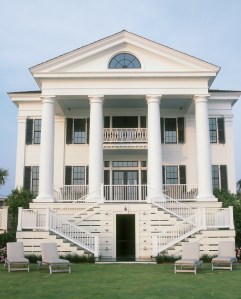
The 20-foot columns and classical façade of Chadsworth Cottage make it a Figure Eight Island landmark. Designer Christine G. H. Franck combined Greek Revival, Federal, and Palladian elements to create this waterfront villa for client Jeffrey L. Davis.

The 20-foot columns and classical façade of Chadsworth Cottage make it a Figure Eight Island landmark. Designer Christine G. H. Franck combined Greek Revival, Federal, and Palladian elements to create this waterfront villa for client Jeffrey L. Davis.

Some houses speak to us. Their voices are honest, eloquent, and deeply resonant. They communicate in a language that is grounded in our architectural history and an authentic local dialect.

Approaching Figure Eight Island, off the coast of Wilmington, North Carolina, is such a house: Chadsworth Cottage. It’s the waterfront home of Jeffrey L. Davis, the founder of Chadsworth’s 1.800.Columns. Its designer, Christine G.H. Franck, is fluent in the classical language that informed its creation. “My primary goal with anything I design is to ensure that it just feels right,” says Franck (a frequent contributor to New Old House). “The language that you use to express the design ideas is an important part of what makes a building feel right, as if it’s supposed to be there.”

Looking at the completed house—and how right it feels—it’s hard to believe that Davis initially considered building a poured-concrete structure, thinking it more likely to survive a hurricane. But because Davis is also a board member of the Institute of Classical Architecture & Classical America, it’s not surprising that he chose a classical model for his new house instead. With the help of a local engineer, he drew up a rough design of a 40′-by-40′ cubic house with four columns on the waterside and a big double-story portico. “When deciding what side of the house to put emphasis on, I chose the waterside; I could envision boats coming down the Intracoastal and seeing this villa rising from the sand,” Davis says. “I also knew this house was going to be all about the details. So very early on I realized I was going to need Christine.”

As one ascends the 10'-wide, three-story staircase from the entry below, the view through the central corridor leads the eye out to the water and the broad horizon. The transverse arch has a historic precedent in this region of North Carolina.

As one ascends the 10′-wide, three-story staircase from the entry below, the view through the central corridor leads the eye out to the water and the broad horizon. The transverse arch has a historic precedent in this region of North Carolina.

For inspiration, Davis began sharing photos of favorite Federal and Greek Revival houses with Franck. But because building codes specify that waterfront homes have an elevated first floor and breakaway construction on the lowest level, a Greek Revival, which sits on a low base, would not be possible. “Jeff was also pulling photos of Palladian villas,” Franck says. “In the end, the direction that made sense was a Palladian villa, with its elevated high base and Roman temple front. We weren’t interested in the house being a strict interpretation of a particular period. We were more interested in letting the classical language and the traditions of the place inform the design project.”

As one ascends the 10′-wide, three-story staircase from the entry below, the view through the central corridor leads the eye out to the water and the broad horizon. The transverse arch has a historic precedent in this region of North Carolina.

Because Davis wanted Chadsworth to look like a surviving remnant of the island’s past, Franck tied the house closely to local tradition, looking specifically to houses in nearby towns like New Bern, North Carolina. “There was not any attempt to be wholly evocative of any time or place in North Carolina,” she says, “but there are specific quotations in the house.” For example, the railing around the southern balcony is based on a bundled wheat design from the historic John Wright Stanly House in New Bern. Full pilasters at the corners were used rather than thin corner boards as “a nod to the late Federal/early Greek Revival tradition in New Bern,” Franck says. “Because much of the Federal-style architecture in New Bern was built rather late, elements of Greek Revival began to sneak in.”

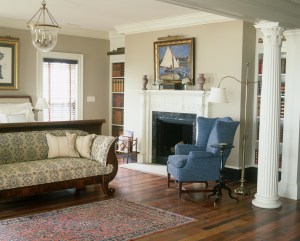
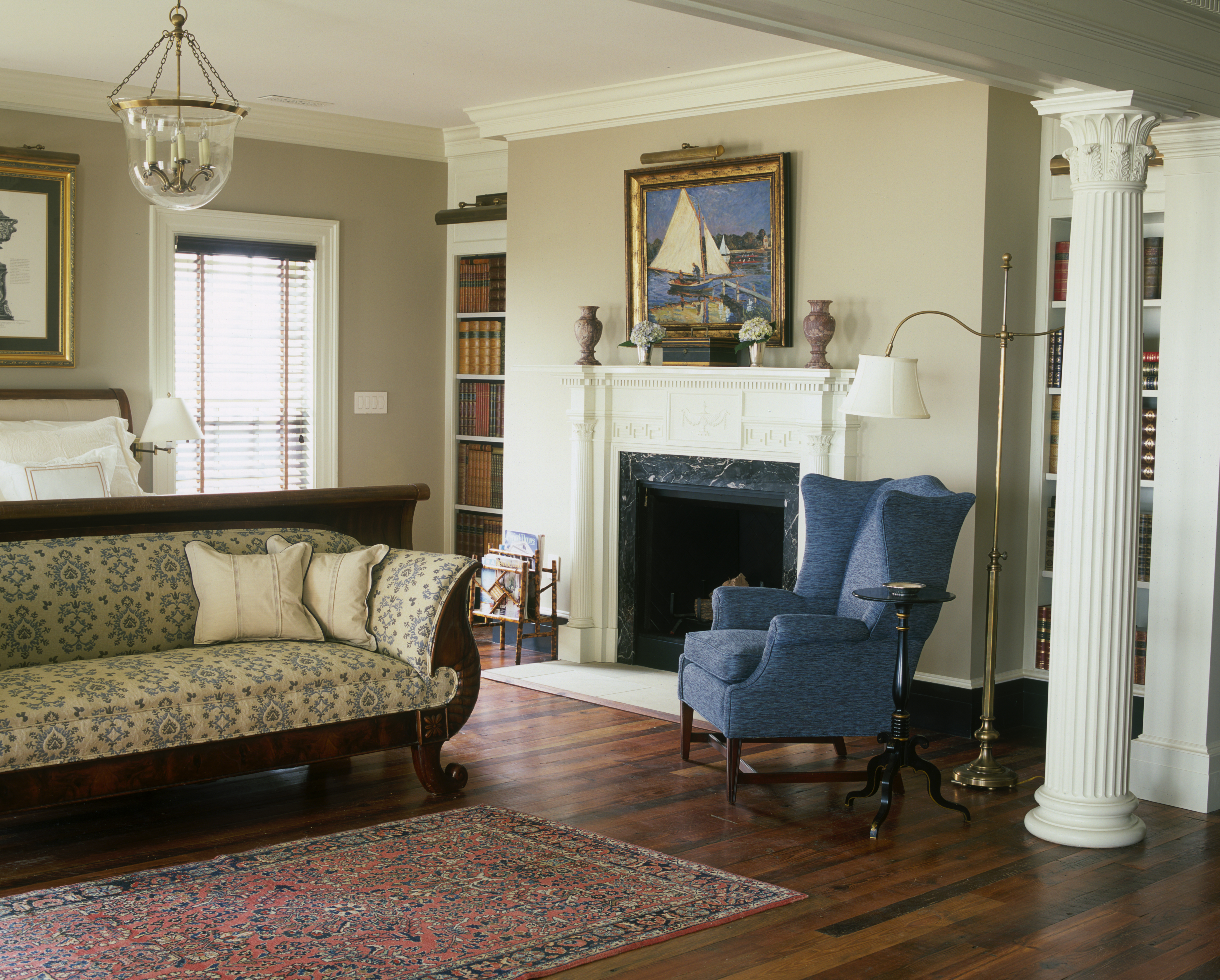
Franck created a tranquil master bedroom with views of the water and a classically styled fireplace. She reupholstered Davis's Biedermeyer sofa in a durable Schumacher fabric as a counterbalance to its formality.

Franck created a tranquil master bedroom with views of the water and a classically styled fireplace. She reupholstered Davis’s Biedermeyer sofa in a durable Schumacher fabric as a counterbalance to its formality.

Inside, the staircase details were inspired by another historic New Bern house, and the elliptical transverse archway on the first floor has a local precedent. “That’s part of the poetry,” Franck says. “Connecting with the place and connecting with a time, so 100 years from now, someone might recognize that some elements came from somewhere else, just as someone would notice today when looking at an old home.”

Of course, the very forces that would make it unlikely an old home might have endured on Figure Eight Island through the ages—hurricanes, high winds, and flooding—were the very forces Franck’s design would have to address if Chadsworth Cottage is to survive into the future. The house is grounded to the site using an interlocking grid of wood pilings that were driven 16′ into the sandy soil and nearly 50 concrete grade beams.

“The engineering is a marvel in itself,” Davis says. “I rode out Hurricane Ophelia in this house for 16 hours, and it was solid.” As protection against both hurricane-force winds and everyday sun, Franck specified Bermuda shutters for the southern windows and found a company that produced PVC shutters that looked as good as traditional wooden shutters but would be more durable in this harsh environment. Franck also turned in part to local builder Jim Murray of Murray Construction for guidance. “All they do is build along the coast, so they have a tremendous body of knowledge,” she says. “When I insisted on wood windows, for example, they explained that during a hurricane, the blowing sand literally sandblasts off the paint, so based on their experience a clad window was best.”

Franck allotted the space at the front of the house for service elements, such as the kitchen and laundry room.

Franck allotted the space at the front of the house for service elements, such as the kitchen and laundry room.

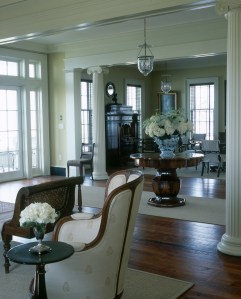
Creating the open floor plan that Davis envisioned posed additional challenges. Considering the dimensions of the house, Franck knew that a truly open floor plan would make it appear that the interior ceilings were lower than they are. Her solution was to run three rooms across the waterfront side of the house—a dining room, a large hall, and a living room—painted in the same color and separated only by column screens. “So you have a living room and dining room in the traditional sense, but they are open to each other and you really occupy those three rooms as one room,” she says. “This way it feels vast because the proportions are better and it picks up on the horizon line outside.”
Another of Davis’s expectations was that the house be built economically using—as much as possible—stock materials. He wanted to demonstrate that building a classical home needn’t break the bank, that it was something anyone can not only aspire to but also achieve. The exterior columns—from Chadsworth’s 1.800.Columns, of course—are in the colossal Tuscan order and made of fiberglass. “It’s a great material to use,” Franck says, “especially when you are talking about 20′-high columns and a beachfront environment. And the Tuscan exterior says ‘This isn’t going anywhere.’”

The living room's club chairs and caned chaise are new pieces chosen for their beauty as well as their durability.

The living room’s club chairs and caned chaise are new pieces chosen for their beauty as well as their durability.

Franck then designated a hierarchy with regard to the orders of columns: Tuscan for the exterior, Ionic for the column screens on the first floor, and Corinthian in the private quarters upstairs. “These are based on specific Grecian models, and the entablatures are a rendition of those Grecian entablatures, but it’s not a temple on the Acropolis. It’s a house, so the details are scaled down appropriately.”

Matters of scale became a primary concern when it came to the interior millwork. “Stock millwork profiles don’t give you the projection or depth that you would like to have in a room that has 10′ ceilings and 8′ doors. You really want something heavier and beefier,” Franck explains. She employed a variety of innovative solutions, including using millwork upside down and combining stock pieces. In the end, the millwork was a combination of half stock and half custom milled. “The primary generator of the house is just simply the classical language working through specific problems that need to be addressed,” she says.

Franck’s confidence in the power of the classical language was put to the test when a question arose regarding the siting of the septic system. Because of the lot’s small size and proximity to water, there was no room for a traditional leach field, so Chadsworth Cottage required an aboveground biofiltration system installed directly in front of the house. Franck was undeterred. “The interesting thing about these sorts of problems,” she says, “is that they are opportunities for design solutions.”

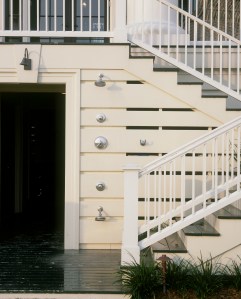
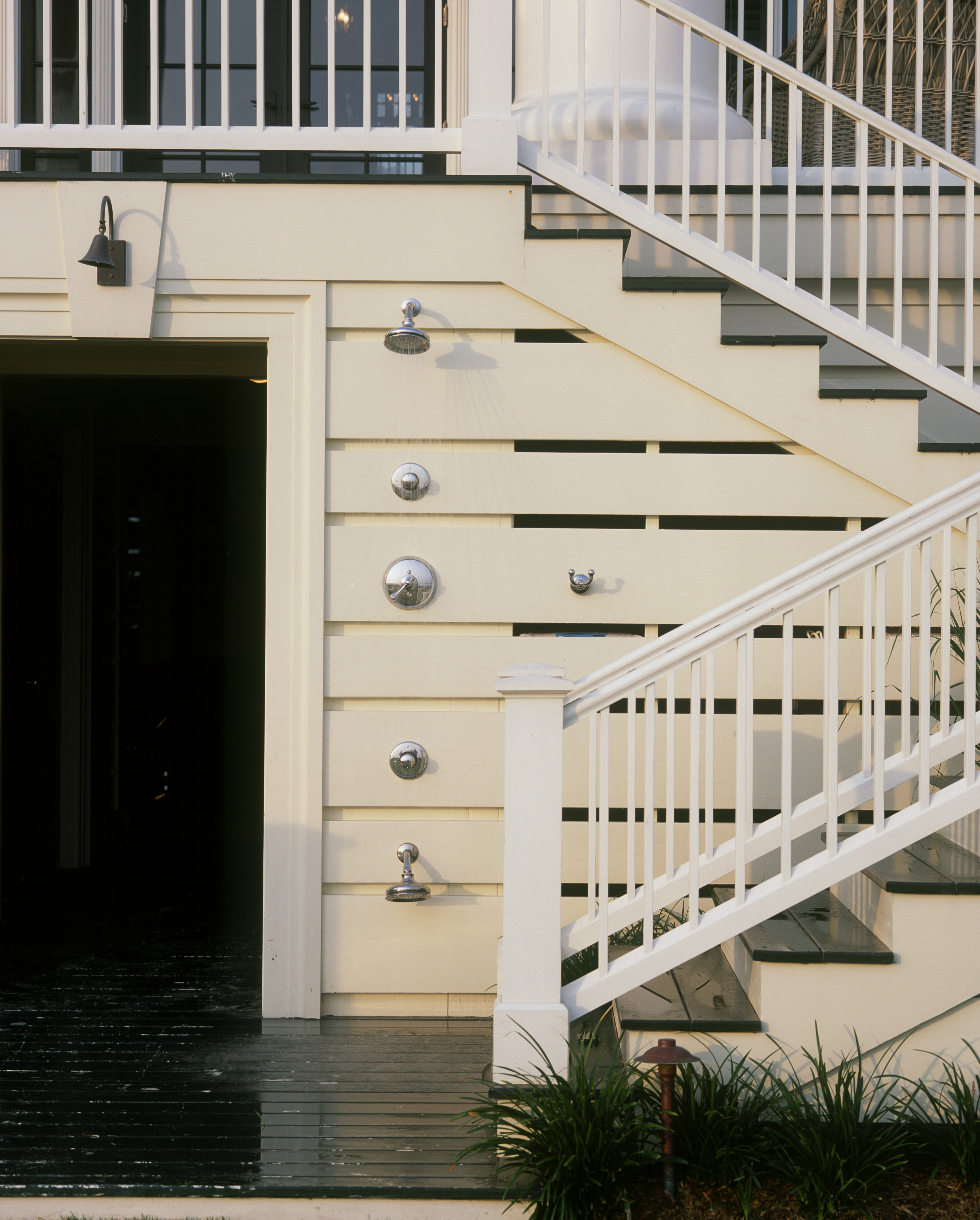
The outdoor shower is a must-have in this beach environment.

The outdoor shower is a must-have in this beach environment.

Her remedy was to construct a pergola covered in wisteria and jasmine that both disguises the septic system and enhances the classical aesthetic. Moreover, the pergola enriches the way in which visitors first encounter the house. “What it does from a design standpoint,” Franck explains, “is that when you arrive from the land side of the house, you have a very constricted approach that heightens the excitement as you pass through the lower entry, rise through the stair hall to the first floor, and turn to see the whole view open up to the landscape and the ocean.”

In the end, Chadsworth Cottage is a model of how a talented designer uses the classical language to solve site-specific problems, accomplish her client’s desires, and remain true to a sense of place and a sense of history, with the result of a new house that faithfully embodies a traditional style. “Moreover,” Franck says “Chadsworth Cottage is a testament to the power of Davis’s vision of a house with that ineffable Southern quality of comfort, good taste, and most importantly, hospitality.”


J. Robert Ostergaard is a freelance writer living in Brooklyn, New York.

Published in: New Old House


Visit Chadsworth’s Online Store at:

SHOP.COLUMNS.COM