
Classical Comments: The Diocletian Window (By Calder Loth – ICAA)

calder-loth-imgBy Calder Loth
Senior Architectural Historian for the Virginia Department of Historic Resources and a member of the
Institute of Classical Classical Architecture & Art‘s Advisory Council.

Courtesy of: the Institute of Classical Architecture & Art  blog.classicist.org/

Dedicated in 306 A.D., the Baths of Diocletian survive as Rome’s only relatively intact ancient bath structure. Its main space, the vast vaulted frigidarium,[i] was preserved by conversion to a church under the direction of Michelangelo in 1563-64.[ii] A distinctive feature of the frigidarium is the series of huge windows along the upper tier of its side walls. (Figure 1) The window form consists of a large semi-circular arch divided into three sections by two thick vertical mullions.[iii] Because of their association with this structure, windows in this configuration are termed Diocletian windows, but we also describe them as thermal windows from thermae, the Latin word for warm bath. The windows’ brick construction was originally veneered with stone moldings and decorations of which only fragments remain in situ. Nevertheless, the form appealed to Renaissance architects who popularized it through treatises and projects. As we see in the following survey, architects have interpreted and applied the Diocletian window in a variety of ways over the past four and a half centuries.

Figure-17

Figure 1. The Baths of Diocletian, Rome (Loth)

Figure-21

Figure 2. Villa Foscari, Italy (Loth)

Andrea Palladio undertook detailed studies of Roman bath ruins with the intention of producing a book on the subject. His project never materialized but various features observed in the ruins found their way into several of Palladio’s designs.[iv] The Diocletian window appears in three of Palladio’s villa elevations published in Book II of I Quattro Libri (1570). Perhaps Palladio’s most prominent Diocletian window dominates the rear elevation of the ca. 1560 Villa Foscari, also known as La Malcontenta. (Figure 2) We have no published drawing of the rear; Palladio’s treatise illustrates only the villa’s portioced façade. Nevertheless, like the ancient prototype, the villa’s huge window is reduced to essentials. Its only ornament is the rustication joints scribed into the stucco.

Figure-31

Figure 3. San Moisè, Venice (Loth)

Palladio set a precedent for incorporating a Diocletian window into the façades of Venetian churches with his designs for San Francesco della Vigna (1566-70) and S. Maria della Presentazione, also known as Le Zitelle, (1577-80).  Palladio also incorporated Diocletian windows in the clerestory of Il Redentore (consecrated 1592). The tradition extended to several later Venetian churches including the façade added in 1688 by Alessandro Tremignon to the church of San Moisè, perhaps the most luscious Baroque façade in Venice. (Figure 3) Though hardly small, the Diocletian window above the entrance is almost overwhelmed by its Baroque encrustations. The window itself is set well back from the heavily decorated arch and mullions. With its sculptures by Heinrich Meyring, the façade is a monument to the Fini family, its patrons.

Figure-41

Figure 4. Gibbs Building, King’s College Cambridge: James Gibbs, A Book of Architecture (1728), plate 34.

In 1724, architect James Gibbs received the commission to design a complex of buildings for the front court of King’s College, Cambridge. Of the three massive structures in Gibbs’s scheme only the West Range, built 1724-31, was realized. For the central pavilions of each front, Gibbs proposed a broad Diocletian window atop a Doric aedicule framing the entrance arch. (Figure 4) This composition closely followed Palladio’s final design for the Villa Pisani at Bagnolo shown in Book II of I Quattro Libri.[v] As illustrated in Gibbs’s A Book of Architecture (1728), Gibbs intended the pediment slopes of the King’s building to be adorned with statues of reclining scholars in the manner of the figures on Michelangelo’s Medici tombs. The sculptures were never realized. Gibbs proposed a similar combination Diocletian window and portico for Whitton Place, Middlesex, but his design was rejected in favor of a design by Roger Morris.[vi]

Figure-51

Figure 5. Chiswick, London (Loth)

Richard Boyle, 3rd Earl of Burlington, was the primary leader of England’s 18th-century Anglo-Palladian movement. His passion for the architecture of Andrea Palladio and his contemporaries inspired his design for his villa at Chiswick. (Figure 5) Completed in 1729, the compact structure exhibited in its forms and details Lord Burlington’s broad knowledge of Palladian architecture. Burlington crowned his house with an octagonal dome prominently fitted with Diocletian windows on its four main faces. The use of this motif was likely inspired by one of Palladio’s early schemes for the Villa Pisani at Bagnolo, the drawing for which was among Burlington’s large collection of original Palladian drawings. (Figure 6) The stair and inset Palladian window in the drawing are features also reflected in Chiswick.

Figure-61

Figure 6. Andrea Palladio, Preliminary design for the Villa Pisani at Bagnolo; pen and brown ink drawing, ca. 1542. (Royal Institute of British Architects)

Figure-71

Figure 7. Mount Clare, Baltimore (Loth)

The lunette in the pediment of Baltimore’s Mount Clare is among America’s very rare Colonial-era versions of the Diocletian window. (Figure 7) Unlike the more standard half-circle examples, Mount Clare’s window is a shallow segment supported with the requisite pair of vertical mullions to give it the thermal form. The voids between the mullions are backed with small window panes. Mount Clare was erected in 1760 as a villa with an extensive park and terraced garden for Charles Carroll, a prominent Maryland patriot. As seen in the illustration, the house walls are laid in header bond, a characteristic feature of the finest colonial Maryland dwellings.

Figure-81

Figure 8. Faneuil Hall, Boston (Loth)

The Diocletian window enjoyed increased though limited popularity during the Early Republic. Boston architect Charles Bulfinch installed them in a handful of his buildings, including his 1805 expansion of the 1742 Faneuil Hall in the heart of Boston. (Figure 8) Bulfinch’s remodeling  involved increasing the original three-bay façade to seven bays and adding the tall third story. To accent the resulting vast pediment, Bulfinch inserted a Diocletian window flanked by two circular windows. Bulfinch gave prominence to the somewhat diminutive Diocletian window by framing it in a broad curved architrave, a trick he used in other designs and one that works effectively in this prodigious structure.

Figure-91

Figure 9. Former Bourse, St. Petersburg, Russia (Loth)

Architect Thomas de Thomon used the Diocletian window with dramatic flair in the attic gable of the St. Petersburg Bourse (Stock Exchange), a monumental landmark on the prow of Vlasilyevsky’s Island, across the Neva from the Winter Palace. (Figure 9) A multiplicity of thin voussoirs forming the arch gives the window the effect of a radiant sun rising from the portico. Partly hiding it, however, is S. Sukhanov’s sculpture group of Neptune with Two Rivers.  Surrounding the building is a peristyle of forty-two unfluted Greek Doric columns, an echo of Paestum. The strategically sited structure served as the center of financial and trade operations for Imperial Russia. Since 1940, the building has housed the Central Naval Museum.

Figure-101

Figure 10. Imperial Stables and Carriage House, Pushkin, Russia (Loth)

We see a more lighthearted use of Diocletian windows on the Imperial stables in Pushkin (formerly Tsarskoye Selo), the suburban town of palaces and parks south of St. Petersburg. (Figure 10) Rendered in Russia’s virile Neoclassical style, the 1820 stable complex was designed by Vasily Stasov and Smaragd Shustov. Here a series of windows punctuates the façade of the stable courtyard. Setting off each window is a thick, plain lintel painted white to contrast with the tan stucco. The curved lintels reflect the semi-circular plan of the courtyard. The battered doorway and keystone focus attention on the center window. Vasily Stasov is best known as the architect of the Winter Palace staterooms, rebuilt after the fire of 1837.
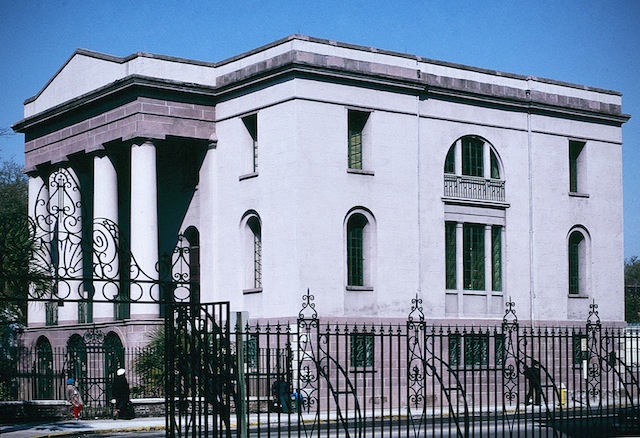
Figure-111

Figure 11. Fireproof Building, Charleston, South Carolina (Loth)

Architect Robert Mills incorporated a Diocletian window in the Meeting Street elevation of the Fireproof Building, constructed 1820-27 as a state office building. (Figure 11) It quickly became known as the Fireproof Building because of its pioneering use of non-combustible materials to protect government records. Though he was a dedicated classicist, Mills used the Diocletian motif in only a few instances. His mentor, Thomas Jefferson, interestingly, applied the motif to none his buildings. In the Fireproof Building, Mills tied the window into a composition embracing the three-part window below. Accenting it is a decorative iron railing, giving a lightness to an otherwise visually solid structure.

Figure-121

Figure 12. Low Memorial Library, Columbia University, New York City (Loth)

The firm of McKim, Mead & White made use of the Diocletian window in a variety of forms in numerous projects. In two of the firm’s most monumental works: Pennsylvania Station (1906-10; demolished 1964) and Columbia University’s Low Memorial Library (1893-95), the widows were of such huge scale that they were divided by four vertical mullions rather than the more standard two. (Figure 12) The use of four mullions at Low Library may have been dictated by the fact that the mullions are metal rather than thick masonry.  Nevertheless, with the window panes set in Roman lattice, the broad composition has a gracefulness despite its size.

Figure-131

Figure 13. Bavarian State Chancellery, Munich, Germany (Loth)

The heavy classicism of Imperial Germany, known as the Wilhelmine style, is boldly exhibited in the central domed section of what is now the Bavarian State Chancellery in Munich. (Figure 13) At the base of the dome is a pedimented pavilion framing a rusticated Diocletian window, a weighty contrast to the window in the Natural History Museum shown below. Designed by Ludwig Mellinger, the building’s center section is all that remained of the 1905 Bavarian Army Museum following the Allied bombing in World War II.  The destroyed wings were rebuilt in 1992 in glassy greenhouse style to house the state legislature and government offices.

Figure-141

Figure 14. Museum of Natural History, Washington, D.C. (Loth)

The firm of Hornblower and Marshall provided our National Mall with a classic Diocletian window set in the open tympanum pediment of the Natural History Museum, built 1901-11. (Figure 14) The allusion to classical Antiquity is reinforced by the use of bronze Roman lattice in the openings. Executed in white granite, the window’s plain architrave frame and vertical mullions lend the composition a restrained monumentality. Below the window is a hexastyle colonnade employing the Corinthian order of the Temple of Castor and Pollux, the three columns of which survive in the Roman Forum. The museum’s pediment and window is one of four identically treated pediments providing buttressing for the dome of this monument of the American Renaissance.

Figure-151

Figure 15. Memorial Gymnasium, University of Virginia, Charlottesville (Loth)

The ancient Roman baths provided excellent precedents for enormous formal enclosures such as railroad stations and gymnasiums. We see this in the University of Virginia’s Memorial Gymnasium, whose form was inspired by the Baths of Diocletian. (Figure 15) Completed in 1924, the design was the product of an architectural commission with Fiske Kimball, founder of the university’s school of architecture, serving as supervising architect. As with the Diocletian bath’s frigidarium, Memorial Gymnasium’s side elevations are composed of a series of gables supporting huge Diocletian windows. The gymnasium’s brick construction reflects the brick walls of the Roman baths, stripped of their stone veneers.

Figure-161

Figure 16. Brooks Brothers Store, Beverly Hills, California (Loth)

[i] The frigidarium was the main space in the bath complex. It was so termed because it contained a series of pools for cold baths.
[ii]
The church name is the Basilica of Santa Maria degli Angeli e dei Martiri. It was further embellished by architect Luigi Vanvitelli in 1749.
[iii]
The bottoms of the arches, where the curve meets the lintel, have been infilled with masonry for extra support, giving the arch a slightly stilted look.
[iv]
Palladio’s drawings of the baths were eventually published by Lord Burlington in 1730, and by Charles Cameron in 1772.
[v]
The portico proposed for the Villa Pisani was not built but the Diocletian window is intact.
[vi]
Terry Friedman, James Gibbs (Yale University Press, 1984), p. 317.

The Rise of Chadsworth Columns – A Discussion with Founder & Principal Designer, Jeffrey L. Davis

THE RISE OF CHADSWORTH COLUMNS

A DISCUSSION WITH FOUNDER & PRINCIPAL DESIGNER – JEFFREY L. DAVIS   

Featured in Period Homes Online Magazine (view article online.)

A Career in Columns

By Gordon Bock

As the essence of ancient Western architecture, columns have been supporting buildings for nearly three millennia, but that doesn’t mean they’ve been unchanged over this long history. Rediscovered during the Renaissance, columns were effectively reinvented in materials as well as uses for the Georgian and Neoclassical styles, and they’ve morphed again with their newfound popularity in the last quarter century. One of the companies that helped bring columns to new heights is Wilmington, NC-based Chadsworth Incorporated, run by Jeffrey Davis.

What drew Davis to columns as a business was not only a love of Classical architecture, but also a fresh perspective on the building material industry. Back in 1987, Davis was working in the telecommunications field in Atlanta, where he had moved right after college. “I think I was 26 at the time,” he says, “and though doing well, I was tired of working for other people and just wanted to start my own company.”

All the while, Davis was studying how building products were being marketed. “Products were going through lumberyards, a two-step distribution system, and I thought that anything out of the ordinary and difficult to deal – like columns – was being mishandled due to miscommunication,” he says, noting that while an architect may know about columns, builders and most other people who go to a lumberyard know little about them. “So I thought that if you went directly from the manufacturer to the end user, working directly with the architect from their plans, you could skip over the two-step distributor system and be profitable – and I was correct.”

Davis recalls how Chadsworth was “kind of successful” right from the beginning. The project that gave them a running start was doing showrooms for Hickory Chair and its parent company, Lane Furniture. Disney World was another large client at the time. “We supplied columns for the MGM back studio tours, where they were re-creating New York street scenes that you can still see,” says Davis. It didn’t hurt that Robert Stern and others were designing houses and condominiums in Florida and other parts of the South that were using columns.

Davis notes that there were also new materials coming out. “Wood columns are what I started with – and they’re still my love – but the industry needed a product that was not wood,” he says, noting that when he studied the fiberglass columns available then, they didn’t look very good. “Everybody’s always trying to produce a less expensive product for the market, so in the wood column industry, you have nice, architecturally correct columns, and then you have builder-grade wood columns, which are less expensive because they are made out of thinner lumber and bases, capitals and astragals that are proportionally leaner. And without thinking about it, those manufacturers were just producing fiberglass columns from the lower-grade wood columns.” In response, Davis decided to take Chadsworth’s top-of-the-line Tuscan column and produce it in FRP (fiberglass reinforced polymer). The result became the start of the company’s PolyStone® line of composite columns.


Stylobate School

Fiberglass columns are typically made with one of two different processes. Filament-wound columns are similar in technology to the large water slides seen at water parks, where the glass fibers and resin are formed into a cylinder. Other columns may be manufactured much as a boat hul isl, with glass fibers and mats laid up in a mold and saturated with resin. Both methods produce a column that is relatively light in weight and therefore easy to install. By comparison, PolyStone® (a technology widely used generically for casting that combines resin and stone dust) is much heavier. “If you had a two-story PolyStone® column,” says Davis, “it would take a crane to install it, whereas three guys could lift and install an equal size spun-cast or laid-up fiberglass column very easily.”

Davis says it’s important for architects to understand that columns in the fiberglass world are sized in nominal dimensions – that is, the closest common value to the dimensions specified, but not the finished dimensions. “Let’s say an architect specifies a 10-in. by 8-ft. column,” he says. “That column is not going to be 10 ins. at the bottom diameter, tapering to 8 inches at the top. Our PolyStone® column, for example, would be 9 5/8 ins. at the bottom, but somebody else who wants to manufacture a less expensive column will make it 9¼ ins. at the bottom.” This is because the price of fiberglass resin fluctuates with the price of oil, and thus the easiest way to reduce the cost of a column is to cut down on proportions. The other way to economize is in mixture. “Cost is also determined by what you mix with the resin – say marble dust,” says Davis. “The more filler you use, the less resin you need, and the price goes down.”


Pillars of a Business

When asked what column among the diverse Chadsworth offerings leads the pack, Davis says it depends upon how you look at it. “In dollar volume it would be our wood columns,” he says, “but in units it would be our PolyStone® columns.” New construction has always been the majority of the business, but over the last few years, sales for restorations and additions have increased. He adds that because the company operates as a mail-order business, and now as an Internet business, it sells all over the world. “In the past few years we’ve shipped to London, the Virgin Islands, Japan, China, Europe, Switzerland, Austria and France,” he says. “Manufacturing is pretty far flung as well, with facilities in Alabama, Utah and Chicago.”

Who buys Chadsworth’s columns? In a residential project, a lot of times the architect calls first, then Chadsworth might – or might not – deal with the homeowner, and then it will probably deal with the builder. Or it might just deal with the homeowner, who will then deal with the builder. “We have to put on several hats in the process,” says Davis. “It just depends upon the type of project.”

The take-on-all-comers concept is not limited to the consumer side either. “Not only do we manufacture our own products, with our online store and with our mail-order business, but we also now distribute a majority of our competitors’ products,” says Davis, noting that it sounds contradictory but, true to form, it’s an idea that serves manufacturers as well as end users. “It started because we had a lot of people call us looking for replacement products – say a column or base they had bought originally from another company – and we wanted to be able to provide that for them.” In fact, several manufacturers felt that since Chadsworth was already talking to the customer, it might as well take care of the sale for them. Davis says that this arrangement supplies a need because there are other manufacturers in the industry who don’t have the sales force or marketing presence to get the reach they deserve. Conversely, it doesn’t make sense for Chadsworth to manufacture every type of product. “We’re never going to make an aluminum column,” says Davis, “but where somebody might want an aluminum column, we want to be able to say we can sell them one.”


Column as They See Them

On top of its over 2,000 standard offerings, Chadsworth doesn’t balk at taking on custom or unusual work if the budget and timing allow. One recent project involved replicating capitals for a historic building in Virginia; another involved creating 300 linear ft. of Tuscan entablature for a job in Jackson, WY. “Personally, I love that work,” says Davis, “because there’s a lot to it and it’s challenging.”

Even though the company’s strength is Classical architecture, Chadsworth doesn’t turn away contemporary architects or concepts. “I think the most original design was an artist’s paintbrush – not a flat house paintbrush but the round kind, which was adapted to work as a column,” says Davis. Chadsworth also handles requests for academically correct columns, such as an order from the University of Notre Dame, where students are building an exacting scale model of one corner of the Parthenon. They also supply pilasters and octagonal columns – “almost anything you can think of,” says Davis.

Not surprisingly, a non-Classical idea can grow into a standard product, such as columns and supports for bungalows and other Arts and Crafts buildings. “I was looking at a couple of books on bungalows, and admiring all the porches in them, and thought, ‘Why aren’t we producing this kind of column?'” says Davis. To make the line readily affordable, as well as a feature a craftsperson or homeowner could use on the jobsite pretty easily, Chadsworth chose to make the bungalow line in a new material, advanced cellular vinyl. And should your Arts and Crafts or Colonial Revival house need the perfect landscape complement, Chadsworth even makes all the parts to build a pergola. While Davis says that pergolas are not a big market, they’re a natural adjunct to the column market and an ideal fit with the business. “They’re not mass produced,” he says. “It’s something unique that each architect or designer can design for themselves – in fact I had one designed for my home.” What better way to enjoy the beauty of columns than as columns for columns’ sake.


Gordon Bock is a writer, architectural historian, technical consultant and lecturer, as well as co-author of the forthcoming book The Vintage House.


The ICA&CA – Classicism in Tropical Hawaii

*Courtesy of the ICA&CA’s Web Site

Classicism in Tropical Hawaii

February 26-March 4, 2011

Arranged by Classical Excursions

Join us on the Institute’s premiere tour of the Hawaiian Islands, where you will be introduced to the diverse and very unique Hawaiian style, from the very first and simple Hawaiian thatched huts called Hale, which were built on the islands some 1500 years ago, to the Missionary Period of the 19th century, when the first prefabricated house arrived from New England, and to the Golden Age of Hawaiian Architecture of the Roaring 1920s, known as the Territorial Period. It was the time when such prominent architects as David Adler, Warren & Wetmore, Julia Morgan, Hart Wood, C.W. Dickey, and Bertram Goodhue were designing houses and public buildings on Oahu. The architecture of Hawaii is as diverse and multicultural as the people who populate the islands. This unique tour includes visits to private houses, public buildings of note, museums, as well as our nation’s only Royal Palace.

Hawaii’s population explosion, as well as increased wealth and tourism, which occurred just after the turn of the 20th century, brought forth the Golden Age of Hawaiian Architecture. Not unlike the mainland, architects and commissioners alike initially looked to Europe for inspiration, creating a flux of buildings in the Beaux Arts, Gothic, and Mediterranean styles.

Through the collective efforts of such prolific architects as Dickey, Hart Wood, and Goodhue, a design approach that was appropriate for both the tropical climate and the distinctively Hawaiian environment was developed. Such features as the “Hickey,” a double pitched hipped roof, lanias or porches, deep roof overhangs, and large open spaces take advantage of the trade winds and remove the barriers that exist elsewhere between indoor and outdoor spaces, creating a vernacular style suitable for the islands. This unique six day-exploration of Classical Hawaii will take the traveler to two of the islands, Oahu and the Big Island of Hawaii. DeSoto Brown, Collections Manager of the Bishop Museum, will lead the tour. Mr. Brown’s family has lived in Hawaii for generations.

Tour Highlights

A six-night stay at the luxurious and historic Royal Hawaiian Hotel, located on the oceanfront at Waikiki Beach. The hotel, designed by Warren & Wetmore and built in the 1920s, still retains much of its original salmon-pink appearance and elegant features, though updated with all the modern amenities.

A private tour of Doris Duke’s famed and exotic Shangri La. Built on five acres overlooking the Pacific Ocean, this was Duke’s most private retreat and was designed and decorated in the Islamic style.

A day on the “Big Island” with an exclusive visit of Keawaiki, a private estate comprising of ten acres of black sand beaches and an artesian spring fed swimming pool carved out of the natural rock. The houses and outbuildings on the compound are constructed of lava rock and date from the 1920s.

A tour of the Iolani Palace, America’s only Royal Palace, built in 1882. It is built in the late Victorian vernacular style with such neo-classical details as cast iron Corinthian columns. Also included is a visit to Queen Emma’s Summer Palace.

Visits to three privately owned houses designed by Bertram Goodhue. One of these houses has the original Hart Wood pool house intact and an authentic imported Chinese pagoda.

A reception at the home (designed by Hart Wood) of one of Hawaii’s top interior designers.

A private tour and dinner at the Liljestrand House designed by Vladimir Ossipoff in 1952 and remaining unchanged since then. The house is considered one of the purest examples of Ossipoff’s work with the original furniture designed by the architect still in place.

The Kawaiahao Church, from 1837, is considered Hawaii’s most significant architectural contribution from the Missionary Period. Built of 14,000 coral blocks cut from reefs located some 10-20 feet below surface, the church took five years to build. It is known as Hawaii’s Westminster Abbey.

Honolulu Hale (City Hall), from 1929 and designed by C. W. Dickey and Hart Wood, is in the California Mission Style.

A private visit to La Pietra, designed in 1922 by David Adler as the residence of Walter Dillingham. The house was modeled after La Pietra in Italy where the Dillinghams were married. Presidents and royalty were entertained at La Pietra, which is now the Hawaii School for Girls.

A tour of the Honolulu Academy of Art designed in 1927 by Bertram Goodhue and Hardie Philips. Such features as the massive tiled Hawaiian roof, entrance arcade, open interior courtyards and use of such local materials as lava rock make this distinctively Hawaiian.

A visit to Julia Morgan’s wonderful Beaux Arts style YWCA from 1927. This is one of the finest examples of European design adapted for local use in the Islands.

A curatorial tour of the Bishop Museum. The Bishop Museum was founded in 1889 by Charles Reed Bishop in honor of his late wife, Princess Bernice Pauahi Bishop, the last descendant of the royal Kamehameha family. The Museum was established to house the extensive collection of Hawaiian artifacts and royal family heirlooms of the Princess, and has expanded to include millions of artifacts, documents and photographs about Hawai‘i and other Pacific island cultures.

An evening Luau on the beach, with Hawaiian food, dance, and music.

Tour price: Land cost is $4,050.00 based on double occupancy. Please contact Classical Excursions to reserve your space. Call (413) 528-3359 or contact@classicalexcursions.com. A tax-deductible $500 donation to ICA&CA is included in the tour price.

Members at the Contributor or Individual ~ Professional level or higher are welcome to attend our tours. Members at the Donor level and higher receive Priority Registration E-alerts before the general public. Join online today or call (212) 730-9646, extension 104 to upgrade your membership.

In addition, participants are required to make a contribution to the Institute’s Annual Fund—which help to further our mission of advancing the practice and appreciation of the classical tradition in architecture and the allied arts. This contribution is fully tax-deductible.


The ICA&CA’s Holiday Party and Raffle Information

*Coutesy of the ICA&CA’s e-newsletter.

Holiday Cocktail Party & Travel Program Raffle
Saturday, December 4, 2010 ~ 6:00–8:00 pm

Sponsored by Stern Projects


ADMISSION

• $125 per person
to attend the party and to be
entered into the Country Houses of
Sir Edwin Lutyens Travel Program

Raffle
($60 is tax-deductible)
Travel Programs >>

• $100 per person
to attend the Holiday Party and
Silent Auction
($35 is tax-deductible)

Racquet & Tennis Club
370 Park Avenue ~ New York, NY 10022
Jacket and tie required for men; equivalent for ladies

Space is Limited ~ Reserve Now
(212) 730-9646, ext. 109

RAFFLE AND SILENT AUCTION

One winner will be drawn at random on December 4. Proceeds benefit the Institute’s educational programs in New York and through its network of chapters nationwide.

Additionally, up for silent auction will be our classical architecture 2011 study abroad program, Rome Drawing & Painting (for one) and a one-week stay (for two) at The Brazilian Court & Beach Club, the historic Palm Beach landmark hotel.

MEMBERSHIP ~ SCHOLARSHIP ~ FELLOWSHIP

Institute of Classical Architecture & Classical America

20 West 44th Street, Suite 310 | New York, NY 10036-6603 | (212) 730-9646
Classicist Blog | @classicist | Facebook | LinkedIn


Chadsworth’s Columns Shown in Elizabeth Locke’s Jewelry Store

Credits:  From the New York Social Diary

                Written By:  Carol Joynt


           http://www.newyorksocialdiary.com/node/1903513


This is what happens in Washington when the calendar begins to move toward autumn:  we think of Virginia, especially the verdant Piedmont region, which stretches from nearby Leesburg down to practically the North Carolina border, with the Blue Ridge to the West and the Potomac to the east.  Within these boundaries are sprawling estates, fox hunts, cattle ranches, vineyards, an evolving colony of artists, trees bearing a dozen or more varieties of apples and pears; abundant good food and a ravishing palette of autumn color.  There’s also, I learned over Labor Day weekend, the lure of luxury – in particular, world class jewelry.


Manhattanites may claim jewelry designer Elizabeth Locke as theirs, but the truth is the lovely pieces she sells on Madison Avenue – and in stores from Charleston to Beverly Hills – are conceived and designed at practically the banks of the languorous Shenandoah River.  All within a few miles of each other are her home in Millwood and her company headquarters in Boyce.  To say it’s a one stoplight rural area is an understatement.  We’re talking one stop sign and a railroad track.


While Elizabeth is a native of the area, which is hard-core hunt country, and her local clients and friends are the landed gentry, her designs are not gold stirrup earrings and horse head pins.  Oh, no.  These are sophisticated baubles for a lux lifestyle:  gems, precious stones, glass intaglios, ancient Roman and Greek coins, South Sea pearls, antique mosaics and lots of gleaming yellow gold.  They reflect the sensibility of Elizabeth, who is, above all, a passport-wielding citizen of the world.


Still, home is where the heart is and for Elizabeth and husband John Staelin their 19th century “farmhouse,” Clay Hill, is another beloved work of art, one they just lavished with a complete upgrade and redo. Anybody who’s ever renovated a house knows completion of the project is a moment for celebration (after months of threatening murder and contemplating suicide).


For Elizabeth and John the job’s end was reason to pitch a big tent, hire a caterer and dance band, and toss a swell party for more than 100 friends.  An added bonus was that it occurred on one of the more spectacular days of the summer, with dry and cool air, and a painter’s sunset.


Elizabeth invited me when she learned I would be a houseguest of our mutual friend Jean Perin who, along with Alison Martin, did the interior makeover of Clay Hill. My friendship with Jeannie dates from the early 80s, when I lived in Upperville and she lived outside Middleburg.


Over the years I relocated to Georgetown and Jeannie settled in Upperville, where she created one of Virginia’s most exquisite mini-estates.  Not only is she a gifted interior designer, but also she makes poetry with landscaping.  Garden groups come from all over to admire Les Jardins de Jean Perin.  It’s a treat to be her houseguest.  Each morning I woke to a view that was a landscape painting.

Given the holiday it was surprisingly easy to get out of the city Friday.  I arrived in time for an afternoon swim and a chance to savor twilight, a quiet intruded upon only by birds, frogs and crickets.  A family of deer romped across the field.


Jeannie is Bunny Mellon’s next door neighbor, though in this part of the world “next door” can mean separated by dozens of acres, even hundreds.  Her many beautiful views include the Mellon jet landing strip, designed to accommodate the latest Gulf Stream.  Only in the land of Mellon could a private airfield be considered beautiful; even the trees are so artfully tended they define well pruned.


In advance of the Clay Hill party Jeannie had some plans for us, but first thing Saturday morning she said, “you must go to see Elizabeth’s store in Boyce.”  Good advice.


It’s a sweet town but completely rural and the last place one expects to find a high-end jewelry emporium that’s done up like an Italian palazzo, but that’s what I found, complete with columns, a hand-painted faux-marble floor, swaths of gold silk, an elaborate ceiling and cases of precious gems.


Bit of the décor are loopy due to a side story Elizabeth created of an imaginary twin sister who is a wayward Contessa, thus the haute invitations tacked to the mirror in the faux bathroom, an alluring boudoir and a shrine to Elvis.  If you arrive minus appropriate clothing, never fear; the shop sells stylish caftans that go well with palazzos, gold and gems.


The store is open on weekends.  It’s less than a half hour from Middleburg and a 70-minute drive from Washington, but loyal customers have been known to fly in private to do their shopping.


Nearby in Millwood is the Locke Store (same name but no relation) where I stopped both coming and going, because the peanut butter chocolate chip cookies were that good.  They have other well made prepared foods, including potpie, meat loaf, chicken salad, assorted sandwiches, apple crisp; also wine, beer sodas and coffee.  Carry your food across the street for a picnic by the cascading race of the restored 18th Century Burwell-Morgan Mill.  That would be a perfect autumn day – history, jewels and a picnic . . .