Unknown's avatar

About Chadsworth Columns

Chadsworth’s 1.800.COLUMNS, founded in 1987, is a leading manufacturer & distributor of architectural columns representing the orders of classical architecture.

New Old House Magazine | Chadsworth Cottage

CHADSWORTH COTTAGE

Classical elements create the perfect new old house in Wilmington, North Carolina.

By J. Robert Ostergaard  |  Photos by Erik Johnson

The 20-foot columns and classical façade of Chadsworth Cottage make it a Figure Eight Island landmark. Designer Christine G. H. Franck combined Greek Revival, Federal, and Palladian elements to create this waterfront villa for client Jeffrey L. Davis.

The 20-foot columns and classical façade of Chadsworth Cottage make it a Figure Eight Island landmark. Designer Christine G. H. Franck combined Greek Revival, Federal, and Palladian elements to create this waterfront villa for client Jeffrey L. Davis.

Some houses speak to us. Their voices are honest, eloquent, and deeply resonant. They communicate in a language that is grounded in our architectural history and an authentic local dialect.

Approaching Figure Eight Island, off the coast of Wilmington, North Carolina, is such a house: Chadsworth Cottage. It’s the waterfront home of Jeffrey L. Davis, the founder of Chadsworth’s 1.800.Columns. Its designer, Christine G.H. Franck, is fluent in the classical language that informed its creation. “My primary goal with anything I design is to ensure that it just feels right,” says Franck (a frequent contributor to New Old House). “The language that you use to express the design ideas is an important part of what makes a building feel right, as if it’s supposed to be there.”

Looking at the completed house—and how right it feels—it’s hard to believe that Davis initially considered building a poured-concrete structure, thinking it more likely to survive a hurricane. But because Davis is also a board member of the Institute of Classical Architecture & Classical America, it’s not surprising that he chose a classical model for his new house instead. With the help of a local engineer, he drew up a rough design of a 40′-by-40′ cubic house with four columns on the waterside and a big double-story portico. “When deciding what side of the house to put emphasis on, I chose the waterside; I could envision boats coming down the Intracoastal and seeing this villa rising from the sand,” Davis says. “I also knew this house was going to be all about the details. So very early on I realized I was going to need Christine.”

As one ascends the 10'-wide, three-story staircase from the entry below, the view through the central corridor leads the eye out to the water and the broad horizon. The transverse arch has a historic precedent in this region of North Carolina.

As one ascends the 10′-wide, three-story staircase from the entry below, the view through the central corridor leads the eye out to the water and the broad horizon. The transverse arch has a historic precedent in this region of North Carolina.

For inspiration, Davis began sharing photos of favorite Federal and Greek Revival houses with Franck. But because building codes specify that waterfront homes have an elevated first floor and breakaway construction on the lowest level, a Greek Revival, which sits on a low base, would not be possible. “Jeff was also pulling photos of Palladian villas,” Franck says. “In the end, the direction that made sense was a Palladian villa, with its elevated high base and Roman temple front. We weren’t interested in the house being a strict interpretation of a particular period. We were more interested in letting the classical language and the traditions of the place inform the design project.”

As one ascends the 10′-wide, three-story staircase from the entry below, the view through the central corridor leads the eye out to the water and the broad horizon. The transverse arch has a historic precedent in this region of North Carolina.

Because Davis wanted Chadsworth to look like a surviving remnant of the island’s past, Franck tied the house closely to local tradition, looking specifically to houses in nearby towns like New Bern, North Carolina. “There was not any attempt to be wholly evocative of any time or place in North Carolina,” she says, “but there are specific quotations in the house.” For example, the railing around the southern balcony is based on a bundled wheat design from the historic John Wright Stanly House in New Bern. Full pilasters at the corners were used rather than thin corner boards as “a nod to the late Federal/early Greek Revival tradition in New Bern,” Franck says. “Because much of the Federal-style architecture in New Bern was built rather late, elements of Greek Revival began to sneak in.”

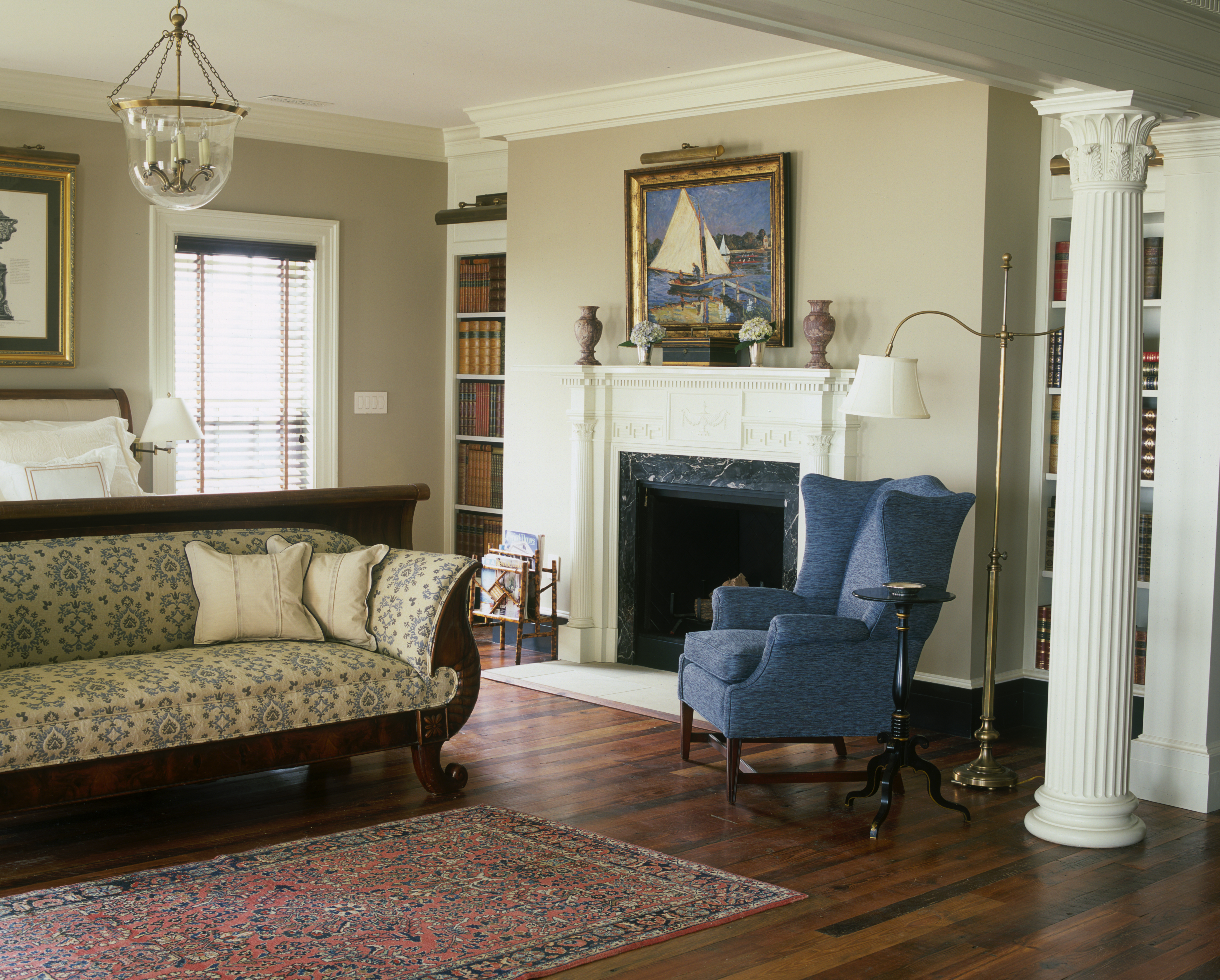
Franck created a tranquil master bedroom with views of the water and a classically styled fireplace. She reupholstered Davis's Biedermeyer sofa in a durable Schumacher fabric as a counterbalance to its formality.

Franck created a tranquil master bedroom with views of the water and a classically styled fireplace. She reupholstered Davis’s Biedermeyer sofa in a durable Schumacher fabric as a counterbalance to its formality.

Inside, the staircase details were inspired by another historic New Bern house, and the elliptical transverse archway on the first floor has a local precedent. “That’s part of the poetry,” Franck says. “Connecting with the place and connecting with a time, so 100 years from now, someone might recognize that some elements came from somewhere else, just as someone would notice today when looking at an old home.”

Of course, the very forces that would make it unlikely an old home might have endured on Figure Eight Island through the ages—hurricanes, high winds, and flooding—were the very forces Franck’s design would have to address if Chadsworth Cottage is to survive into the future. The house is grounded to the site using an interlocking grid of wood pilings that were driven 16′ into the sandy soil and nearly 50 concrete grade beams.

“The engineering is a marvel in itself,” Davis says. “I rode out Hurricane Ophelia in this house for 16 hours, and it was solid.” As protection against both hurricane-force winds and everyday sun, Franck specified Bermuda shutters for the southern windows and found a company that produced PVC shutters that looked as good as traditional wooden shutters but would be more durable in this harsh environment. Franck also turned in part to local builder Jim Murray of Murray Construction for guidance. “All they do is build along the coast, so they have a tremendous body of knowledge,” she says. “When I insisted on wood windows, for example, they explained that during a hurricane, the blowing sand literally sandblasts off the paint, so based on their experience a clad window was best.”

Franck allotted the space at the front of the house for service elements, such as the kitchen and laundry room.

Franck allotted the space at the front of the house for service elements, such as the kitchen and laundry room.

Creating the open floor plan that Davis envisioned posed additional challenges. Considering the dimensions of the house, Franck knew that a truly open floor plan would make it appear that the interior ceilings were lower than they are. Her solution was to run three rooms across the waterfront side of the house—a dining room, a large hall, and a living room—painted in the same color and separated only by column screens. “So you have a living room and dining room in the traditional sense, but they are open to each other and you really occupy those three rooms as one room,” she says. “This way it feels vast because the proportions are better and it picks up on the horizon line outside.”
Another of Davis’s expectations was that the house be built economically using—as much as possible—stock materials. He wanted to demonstrate that building a classical home needn’t break the bank, that it was something anyone can not only aspire to but also achieve. The exterior columns—from Chadsworth’s 1.800.Columns, of course—are in the colossal Tuscan order and made of fiberglass. “It’s a great material to use,” Franck says, “especially when you are talking about 20′-high columns and a beachfront environment. And the Tuscan exterior says ‘This isn’t going anywhere.’”

The living room's club chairs and caned chaise are new pieces chosen for their beauty as well as their durability.

The living room’s club chairs and caned chaise are new pieces chosen for their beauty as well as their durability.

Franck then designated a hierarchy with regard to the orders of columns: Tuscan for the exterior, Ionic for the column screens on the first floor, and Corinthian in the private quarters upstairs. “These are based on specific Grecian models, and the entablatures are a rendition of those Grecian entablatures, but it’s not a temple on the Acropolis. It’s a house, so the details are scaled down appropriately.”

Matters of scale became a primary concern when it came to the interior millwork. “Stock millwork profiles don’t give you the projection or depth that you would like to have in a room that has 10′ ceilings and 8′ doors. You really want something heavier and beefier,” Franck explains. She employed a variety of innovative solutions, including using millwork upside down and combining stock pieces. In the end, the millwork was a combination of half stock and half custom milled. “The primary generator of the house is just simply the classical language working through specific problems that need to be addressed,” she says.

Franck’s confidence in the power of the classical language was put to the test when a question arose regarding the siting of the septic system. Because of the lot’s small size and proximity to water, there was no room for a traditional leach field, so Chadsworth Cottage required an aboveground biofiltration system installed directly in front of the house. Franck was undeterred. “The interesting thing about these sorts of problems,” she says, “is that they are opportunities for design solutions.”

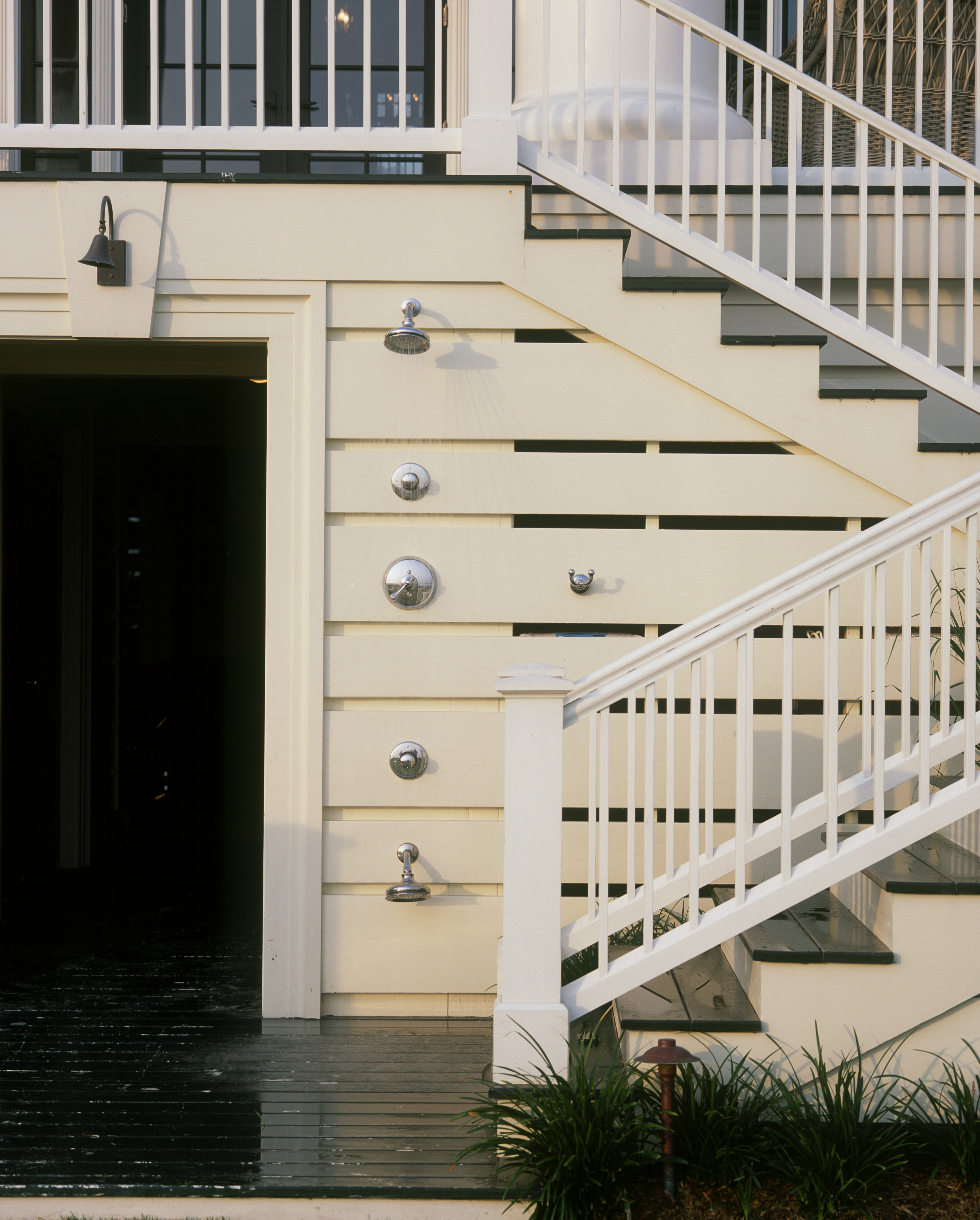
The outdoor shower is a must-have in this beach environment.

The outdoor shower is a must-have in this beach environment.

Her remedy was to construct a pergola covered in wisteria and jasmine that both disguises the septic system and enhances the classical aesthetic. Moreover, the pergola enriches the way in which visitors first encounter the house. “What it does from a design standpoint,” Franck explains, “is that when you arrive from the land side of the house, you have a very constricted approach that heightens the excitement as you pass through the lower entry, rise through the stair hall to the first floor, and turn to see the whole view open up to the landscape and the ocean.”

In the end, Chadsworth Cottage is a model of how a talented designer uses the classical language to solve site-specific problems, accomplish her client’s desires, and remain true to a sense of place and a sense of history, with the result of a new house that faithfully embodies a traditional style. “Moreover,” Franck says “Chadsworth Cottage is a testament to the power of Davis’s vision of a house with that ineffable Southern quality of comfort, good taste, and most importantly, hospitality.”


J. Robert Ostergaard is a freelance writer living in Brooklyn, New York.

Published in: New Old House


Visit Chadsworth’s Online Store at:

SHOP.COLUMNS.COM

Arts & Crafts Homes and the Revival Magazine Feature Chadsworth Columns

Featured in the Fall 2006 Arts & Crafts Homes and the Revival Magazine


A LEITMOTIF OF ARTS AND CRAFTS INTERIORS:  the adaptable, architectural colonnade.  Old ones are being stripped and refinished, new ones built in revival homes.  Several column and millwork manufacturers, in fact, have introduced tapered pillars and colonnades as stock designs, such as Chadsworth’s “Bungalow Column” in paint-ready plain or paneled styles [columns.com]  ?  Room-dividing colonnades usually appear in mirror-image pairs, the two sides often surmounted by a beam or arch.  Pillars may be set atop a pedestal wall knee- to chest-high, perhaps incorporating built-in bookcases, glass-fronted china cupboards, or a bench seat.  Both round columns and square pillars appear in period millwork catalogues; colonnades of oak or chestnut were clear-finished.  Painted colonnades, too, were in evidence and are particularly popular in the revival.  Those shown below were designed by Moore Architects [(703) 837-0080, moorearch.com] in Arlington, Virginia, as part of a radical remodeling in an interpretive Craftsman style.       – P.POORE


Chadsworth — The Preferred Vendor for Architectural Columns — According to the New York Times

           The New Old House By PENELOPE GREEN


IT’S an American ideal, particularly in some parts of the Northeast. It is both a trophy and a lifestyle, not to mention the engine behind a thriving publishing category: the renovation memoir. It is the old house, a perennial best seller. But for some — call them fastidious, time-deprived or just coolly unsentimental — the bloom is off that particular rose. Not that these buyers are scarfing up contemporary houses or building their own. They still have an appetite for the premodernist, prewar styles, but they cannot stomach their realities: the dark rooms and the little windows, the dank basements and the creaky floors, the wiring that can barely support a fan’s rotation (never mind central air-conditioning). They want a new house that reads old. They want a new old house.


“There are so many people who want things to be exactly right,” said Michelle Kirby, a broker at Gustave White Sotheby’s International Realty in Newport, R.I. “They want it turnkey, and they don’t want to have to think about it. Construction costs are really high, renovations are really hard, and people know that. The ideal is what I call the Pottery Barn formula house: shingle-style exterior, white Carrera marble kitchens and the white subway tile in the bathrooms, so it looks like the background in the catalog. It’s trite, but it’s so sellable.”


In Sullivan County, N.Y., the ideal may be a clapboard farmhouse, its lines as simple as a child’s drawing. Andrew Deitchman, 36, had that image in mind when he and his fiancée, Heather Baltz, 28, went house hunting in the Catskills last spring.


“I’d always wanted that sort of old house,” said Mr. Deitchman, a partner at Mother New York, a boutique advertising agency in Manhattan. “In my head I wanted the place I could putter around in and fix up and make my own. But Heather said, ‘Don’t be stupid, we don’t have time.’ ”


Mr. Deitchman and Ms. Baltz, a personal trainer, are opening an artisanal hot dog stand in Bleecker Park next week (it will be called Dogmatic) with their partner, Jeremy Spector, the chef at Employees Only in the West Village. The next week, the couple will be married.


To Ms. Baltz’s consternation, Mr. Deitchman said, he made an offer on just such a place. Fatefully, the bid was not accepted (“and the house turned out to have all sorts of issues,” Mr. Deitchman said), and last month they bought a bright yellow clapboard simulacrum for $365,000. It has nice period details like a back porch, vintage radiators and footwide pine plank floors. But the subfloor is straight and true, the basement dry and roomy. The house is also only three years old.


It is a kit house designed by Randy Florke, an interior designer, contributing editor at Country Living magazine and real estate broker who has transmogrified much of Sullivan County into a scrubbed-clean version of itself.


After buying, renovating and selling the genuine article, Mr. Florke perceived a business opportunity. Since the debut of his kit houses in an issue of Country Living two years ago, Mr. Florke has received 5,200 requests for them. They range from $125,000 to $300,000 and were designed in honor of the Nebraska farmhouses he grew up in.


“It’s funky up here, and you want to have a place that fits that,” Ms. Baltz said of her new Catskill neighborhood. “But I was after something simple. I didn’t want the scary basement and all the work. So this house looks right, but it also smells good and is full of light, and there’s nothing to fix.”


In sleepy Madison, Conn., Margaret Muir showed an early-20th-century waterfront “cottage” listed for $2.5 million to a young man who had expressed a desire for something historic.


“We walked in and he said, ‘But the floors are slanted; do you think they could fix that?’ ” said Ms. Muir, a broker at William Pitt Sotheby’s International Realty. “It was like no one had noticed for the last 90 years. Having expressed a desire for vintage, there was some alarm about the floor. He did not make an offer. These buyers want the charm on the exterior, but the creature comforts inside: an open layout, central air, nice bathrooms. You used to get people who loved the creaky uninsulated cottages with one bathroom; they wanted the kids to run in and out with sandy feet. They’d say, ‘I’ve got perfect in my other life, I don’t need perfect here.’ But I don’t hear that anymore.” She added, “To be fair, values here have increased so much there’s a disconnect if you don’t upgrade.”


Jane Wallace, a real estate agent with Schweppe Burgdorff ERA in Montclair, N.J., said new old houses there have appealed to two-income families in the waning years of low mortgage rates.


“If you both have jobs,” she said, “why would you want another job as general contractor? Would you rather buy the paint yourself, or mortgage the paint and get a tax deduction? Do you need the romance, the story that goes along with fixing up an old house? Nah.”


Inspiration for buyers of new old houses can be found in New Old House, a quarterly spinoff of Old-House Journal, the restoration movement’s purist bible. The new magazine began publishing two years ago in response to readers’ requests, said its editor, Nancy Berry.


“Our market research told us that there’s a real craving for a not-cookie-cutter house that has character and texture and is based on a traditional vocabulary that functions new,” she said, “rather than for a fixer-upper made from your blood and sweat and tears and money.”


New Old House’s circulation is 100,000; Restore Media plans to publish it every other month beginning in 2008.


In the Hamptons, a broker who listed what he called a magnificent Victorian is finding that many would-be buyers are wrinkling their nose at it. He described one woman’s terse dismissal: “She said, ‘Old house: dirty!’ ”


What is selling quickly out there, said Alice Bell, manager of the East Hampton office of Sotheby’s International, are the mega-spec houses designed by high-end East End contractors like Jeffrey Collé and Michael Davis. These are vast, shingle-style environments with flooring reclaimed from centuries-old houses, handblown glass butler’s cabinets and more systems than can be found on an ocean liner: hydronic heating, geothermal cooling and remote-controlled everything.


“The Hollywood people who came here in the 80’s and 90’s liked the old houses,” Ms. Bell said. “They were happy with the old shingled cottage. This buyer, the younger investment bankers we’ve seen in the last few years, they want a total environment in an old-looking shell. And they’re looking for a turnkey situation.”


REAL estate is cyclical and generational, said Frank Newbold, a veteran broker in Ms. Bell’s office. “Fifteen years ago the old shingle-style house was a trophy here,” he said, “because it reminded you of the house you grew up in, or wished you’d grown up in.” New money then aspired to an older ideal, he said. “Ten years ago the buyer wanted shiny and new, without regard for taste,” he continued. “And right now they want a hybrid, the new house with a little bit of soul, a little bit of texture.”    


The house they are after, he said, “maybe it’s 10,000 square feet but it’s got 200-year-old ‘foot-worn’ floors.”


He added: “Gas fireplaces are the other big thing, that you turn on by remote from the sofa. CNN and a fire! People will pay for the patina, but what they’re really short on is time. So they’re buying these branded properties created by name contractors that are massive but still tasteful.”


In the hothouse atmosphere of Long Island’s East End, these massive new old houses take extraordinary forms.


Last week Mr. Collé stood in the newly sodded field behind the 16,000-square-foot, gabled spec house he had signed into contract that morning for over $20 million to an entrepreneur from Philadelphia. It was just under 100 degrees in the hazy sun, but Mr. Collé, a gentle, affable man who had restored some of the great estates on the North Shore under his father and grandfather 35 years ago and then on his own for Alec Baldwin, Billy Joel, Donna Karan and Stephan Weiss, was crisp in his white dress shirt, untucked over khaki pants and Timberland boots.


Inside, there were handblown leaded glass transoms and cabinets, dense and creamy plaster walls and acres of 19th-century walnut flooring from an architectural salvage dealer “out west.” (Mr. Collé likes to keep his sources to himself.)


Unlike the 200-year-old “foot-worn” flooring in the 7,500-square-foot white clapboard antebellum pile Mr. Collé sold two months ago for $12.75 million to a young investment banker and his family (Mr. Collé built it for himself after seeing “Forrest Gump,” he said), this flooring took a bit of work to mellow (stored in a shipyard for pallets for the past 100 years or so, the wood had never felt a foot). He proffered an undulating sample, its declivities smoothed in by hand (not foot).


“Here’s why my houses are selling,” Mr. Collé began, sketching in the air with his hands. “They come out here to buy a house, and there’s nothing in their price range in the old stock. So they can buy a piece of land, wait through the mysteries of the zoning process, look for an architect, and try and get a plan going.


“Maybe two years have gone by. Then it goes to bid, and maybe they find a contractor and start building. Three years have gone by. Now there’s a decorator, an architect, a builder, and they’ve got to spend their weekends choosing hardware. Maybe they are four years out and they still don’t have a house. Do you think Mr. Investment Banker wants to go through this process?”


Certainly not.


Shingle-Style Houses and Salvaged Doors

HOUSES Randy Florke’s clapboard farmhouse kit can be purchased at theruralconnection.com (212-645-4488). A house that is 1,800 square feet costs about $300,000, including assembly and all systems, and can be delivered and built anywhere along the Northeast corridor, from Maryland to Maine.


On the East End of Long Island, Michael Davis, a contractor, builds English country houses. A 4,500-square-foot shingle-style house with limestone fireplaces on half an acre in Sagaponack, which will be finished next summer, will cost $5 million (631-537-4444; michaeldavis.com).


Jeffrey Collé’s company, J. C. Construction Management, is building new old houses on a larger scale in the same area at a rate of two every year and a half. An 8,500-square-foot house on 42 acres in Bridgehampton with hand-hewn trusses salvaged from old barns, which will be completed next spring, is expected to sell for $30 million (631-324-8500).


ACCESSORIES Chadsworth’s 1.800.Columns, based in Wilmington, N.C., sells historically accurate architectural columns made from wood and composite materials (800-265-8667; columns.com). A column that is 10 feet high and 8 inches in diameter sells for $200 to $1,000.


Eldorado Stone, made from Portland cement, mimics regional stone varieties (from river rocks to limestone) and comes in veneers for all architectural styles (eldoradostone.com; 800-925-1491). Eldorado Stone, in San Marcos, Calif., sells stone veneer for $7 to $9 a square foot, uninstalled.


Old West Woods in Elida, Ohio, sells hand-hewn beams taken from old barns and industrial buildings, as well as antique and wide-plank flooring it can mill to any size (419-339-7600; oldwestwoods.com). Antique oak flooring that is 3 to 12 inches wide sells for $7 to $15 a square foot.


Sylvan Brandt, in Lititz, Pa., sells antique flooring, doors, mantels, cupboards, beams and hardware (sylvanbrandt.com and oldhousestuff.com; 717-626-4520). A salvaged door that measures 80 inches high by 30 to 35 inches wide sells for $80 to $125.

Authentic Columns Featured in ‘The Toolbox’ of “Walls & Ceilings Magazine”

Chadsworth’s 1.800.COLUMNS Authentic Replication Columns & Pilasters were featured in The Toolbox in the May issue of Walls & Ceilings Magazine. 


The Authentic Replication Columns are from Chadsworth’s Premier Custom Collection.  The company replicates ‘classical specifications’ by integrating  the original formulas with computerized technology in order to achieve a precisely-proportioned finished product.  The columns are made from the finest wood available (Western Red Cedar, Clear Heart Redwood, mahogany, teak), with plain or fluted shafts.  They are available in the following sizes:  8″ x 8′ up to 20″ x 22′.  The load-bearing columns may be used for interior or exterior projects.


“Columns add classical interest to any design,” says Jeffrey L. Davis — Founder of Chadsworth Incorporated — “and accent the crown molding in any room.”


For more information:  www.COLUMNS.com

Chadsworth’s 1.800.COLUMNS Authentic Replication Columns and Pilasters

WILMINGTON, N.C., June, 2006 Chadsworth’s 1.800.COLUMNS Authentic Replication Columns and Pilasters were featured in “The Toolbox” in the May issue of Walls & Ceilings Magazine.  The Authentic Replication Columns are from Chadsworth’s Premier Custom Collection.  The company replicates ‘classical specifications’ by integrating the original formulas with computerized technology to achieve a precisely proportioned finished product.  The columns are made from the finest wood available (Western Red Cedar, Clear Heart Redwood, mahogany, teak), with plain or fluted shafts.  They are available in the following sizes:  from 8″ x 8′ up to 20″ x 22′.  The load-bearing columns may be used for interior or exterior projects.


“Columns add classical interest to any design,” says Jeffrey L. Davis, the Founder and Principle Designer of Chadsworth’s 1.800.COLUMNS, “and accent the crown molding in any room.”