Unknown's avatar

About Chadsworth Columns

Chadsworth’s 1.800.COLUMNS, founded in 1987, is a leading manufacturer & distributor of architectural columns representing the orders of classical architecture.

Greek Excursion – Jan Gleysteen Architects

Source:  http://www.traditionalbuildingportfolio.com/projects/residential/greekexcursion.html

Greek Excursion

A run-down house in Massachusetts is reborn as a Greek Revival residence.

Project: Residence, Weston, MA

Architect: Jan Gleysteen Architects, Wellesley, MA; Jan Gleysteen, NCARB, AIA, principal

By Annabel Hsin

On a picturesque Saturday morning, architect Jan Gleysteen and his son drove to the quaint coastal Maine town of Wiscasset to visit a collection of Greek Revival houses built between 1820 and 1845. They spent the afternoon photographing, measuring and documenting various architectural details and conducted case studies of four houses. The research was for a project in Weston, MA, in which the owners of a run-down Cape structure approached Gleysteen, principal of Wellesley, MA-based Jan Gleysteen Architects, with the goal of rebuilding their house.

“The clients came to me and said they wanted a Greek Revival house that reflects early American democracy,” says Gleysteen. “I’d never designed a Greek Revival, but had studied the style when I was a student under Robert Stern, who told us to go and measure everything. By the time I received this assignment a couple of decades later, I had the academic orientation to go about designing this house.

“There are many Greek Revival examples in Weston, but I did most of my research in Wiscasset because it’s a beautiful town and there are more than a dozen houses side by side,” he adds. “I could compare one house to another, and I found very little variation, so it gave me a basis of confirming that the dimensions were correct. Whereas in Weston, the houses were scattered, and it was an agrarian community until the late-19th century.”

Adjacent to a 30-acre communal farm, the site is located on a busy road with restrictive zoning. In order to comply with the zoning restrictions, a small portion of the original house and most of the original foundations were retained. “Even though there was virtually nothing left of the original house, which was in terrible condition,” says Gleysteen, “we had to build a new home on the existing foundation.”

The program called for the space of a typical five-bedroom suburban house with a kitchen, living, dining, family and breakfast rooms as well as a pantry, mudroom and two-car garage, resulting in a 4,800-sq.ft. structure. To disguise the home’s true size, Gleysteen split the program into two back-to-back gabled wings and arranged them in a pinwheel plan to enclose a hidden, flat rooftop at the center.

“The key to the scale was to not allow the roof ridge to keep rising up,” says Gleysteen. “On the front façade, the roof ridge stops at 15 ft. but the depth of the house is 47 ft. If we placed the ridge in the middle, like most houses, it would be 24 ft. high. When viewed from any angle, our depth illusion is what appears to be a 2,000-sq.ft. house.”

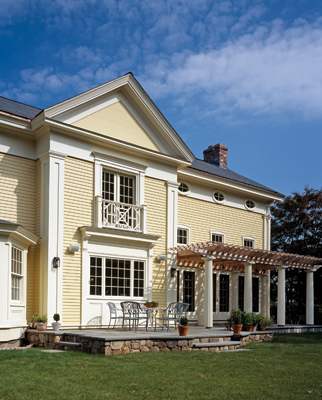
Below the roofline, details from the Wiscasset case studies were replicated on the exterior. The front elevation consists of a main gable and a side porch with the main entry placed at the center. The façade is complemented with recessed corner pilasters, western red cedar siding and double-hung windows with operable shutters as well as surrounds that were inspired by the temple form. Beneath the porch, there are fluted Doric columns, triple-hung windows and a French side door with exaggerated crossbars to resemble the windows. Above the second floor, a tall horizontal frieze extends across the entire façade. The rear elevation contains identical details but the main gable is placed at the center and the porch is replaced with a pergola and three sets of French doors; a bluestone terrace completes the outdoor gathering space.

“The half-round windows on the elevations were idiosyncratic design elements from the early-19th century that aren’t repeated today,” says Gleysteen. “Today, those would be perfect half-round windows. Instead, these have a large solid starting base for the spoke mullions to meet; it’s more of a sunburst. The other unique detail is the oval attic windows – a coastal variation inspired by maritime portholes on a sailing ship.”

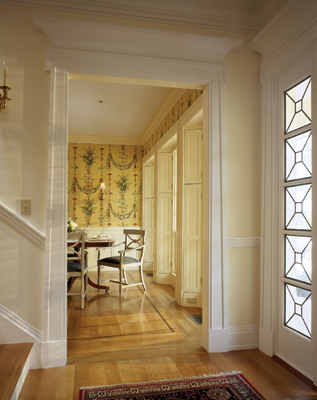
Through the main entry, the foyer, parlor, library alcove and dining room make up the formal living spaces and contain Greek Revival details that were rigorous in their replication. The dining room features crown molding, wainscoting and window casings with operable angled shutters. The door surround supports an over-scaled crown that was another detail of the style inspired by Egyptian forms.

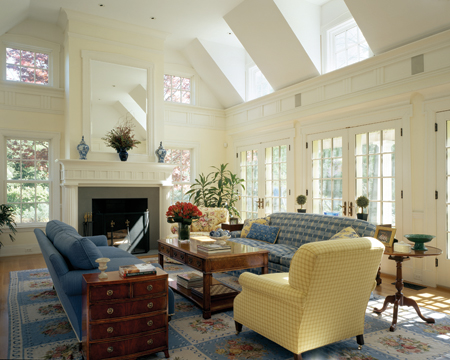
Toward the rear, the family room and kitchen share a large open space. The family room is one-and-a-half stories high with two levels of windows and French doors to allow natural light in. Its focal point is a fireplace with Classical details, Doric columns and a mirror resembling a temple above the mantel.

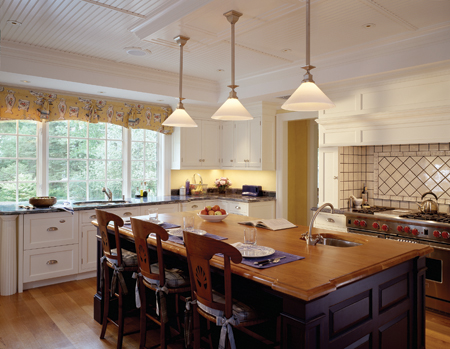
At the center of the kitchen, a large island is topped with marine-grade, finished teak. Shaker-style cabinets and imported Bahia blue granite countertops complement the large window over the sink. A bead-board ceiling and an exaggerated crown housing recessed lights complete the room. White oak floors were installed throughout to unite the casual and formal spaces.

“The island is the most important element in our kitchen designs,” says Gleysteen. “In this case, we designed a center panel for the chandeliers over the island to strengthen the central space. Each light attaches to the panel that has a stepped profile, which was influenced by Art Deco – the style correlates with Greek Revival in its use of geometry.”

Adjacent to the kitchen, the mudroom is treated as a second front door with accommodations for closets, cubbies, a bathroom and access to the garage. Antique limestone was installed in an ashlar pattern on the floor and the steps leading to the garage are bluestone.

The use of classic Beaux Art axial geometry improves the interior flow and draws attention to the exterior views. “When you enter from the garage, you’re on axis to the kitchen that leads to the family room and ends with a window,” says Gleysteen. “Conversely, through the front door to the left, you can look straight through into the family room and there’s a glimpse of the rear yard beyond. There’s another sightline from the dining room, through the butler’s pantry, to the large window over the kitchen sink.”

Upstairs, the master suite – consisting of a bedroom, dressing room, master bath and a large study – along with two other bedrooms, a bathroom, an additional bedroom suite and a laundry area, are organized around the central hall, which is illuminated by a skylight. Light fixtures beside the skylight are set in panels with the same design as the one above the kitchen island. The ceiling is accentuated with a distinctive cove-shaped Greek key molding below the crown.

Key manufacturers and suppliers for the project included Wausau, WI-based Kolbe & Kolbe Millwork (windows); Wilmington, NC-based Chadsworth Columns; Montgomeryville, PA-based Tim-berlane (shutters and shutter hardware); Branchburg, NJ-based Hahn’s Woodworking Company (garage doors); and Portland, OR-based Rejuvenation (interior lighting).

“This project was a labor of love,” says Gleysteen. “We’re very passionate about historic American architectural styles and it was a really fun adventure. We’re pleased about the rigorous research we conducted, having the chance to measure everything and using our background in construction detailing to replicate these details. This project is a rarity because not everyone does it, and I would love to see more Greek Revival-inspired architecture built.”

Jan Gleysteen Architects of Wellesley, MA, renovated a run-down Cape structure in Weston, MA, to reflect Greek Revival precedents and early American democracy. The 4,800-sq.ft. house comprises a kitchen, living, dining, family and breakfast rooms as well as a pantry, mudroom and two-car garage. All photos: Sam Gray
Jan Gleysteen Architects of Wellesley, MA, renovated a run-down Cape structure in Weston, MA, to reflect Greek Revival precedents and early American democracy. The 4,800-sq.ft. house comprises a kitchen, living, dining, family and breakfast rooms as well as a pantry, mudroom and two-car garage. All photos: Sam Gray

The one-and-a-half-story family room shares an open space with the kitchen. It features two levels of windows and French doors, as well as a Classically-detailed fireplace.
The one-and-a-half-story family room shares an open space with the kitchen. It features two levels of windows and French doors, as well as a Classically-detailed fireplace.

A marine-grade, finished-teak island anchors the kitchen. White oak floors unite the casual and formal spaces and complement the bead-board ceiling and Shaker-style cabinets.

A marine-grade, finished-teak island anchors the kitchen. White oak floors unite the casual and formal spaces and complement the bead-board ceiling and Shaker-style cabinets.

A skylight illuminates the second-floor central hall, around which the master suite, two bedrooms, a bathroom, an additional bedroom suite and a laundry area are organized.
A skylight illuminates the second-floor central hall, around which the master suite, two bedrooms, a bathroom, an additional bedroom suite and a laundry area are organized.

As viewed from the main entry, the dining room contains Greek Revival details such as crown molding, wainscoting and window casings with operable angled shutters. The door surround supports an Egyptian-inspired over-scaled crown.

As viewed from the main entry, the dining room contains Greek Revival details such as crown molding, wainscoting and window casings with operable angled shutters. The door surround supports an Egyptian-inspired over-scaled crown.

Off the second-floor central hall, the master suite consists of a bedroom, dressing room, master bath (pictured) and a large study.
Off the second-floor central hall, the master suite consists of a bedroom, dressing room, master bath (pictured) and a large study.

The rear elevation is detailed to match the front facade, but features a centered main gable, pergola and three sets of French doors that lead to a bluestone terrace.

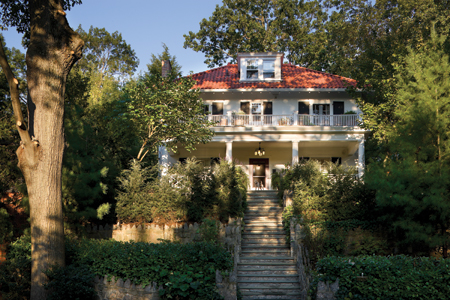
The rear elevation is detailed to match the front facade, but features a centered main gable, pergola and three sets of French doors that lead to a bluestone terrace.
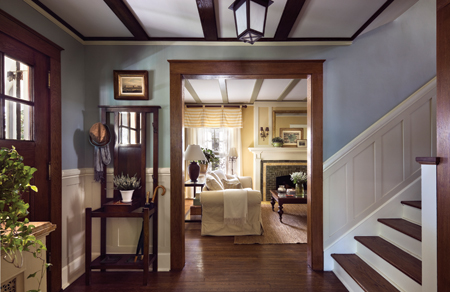
Not by the Book – Gary L. Brewer, AIA, New York, NY

Source:  http://www.period-homes.com/Previous-Issues-13/MarchProject13Brewer.html

Not by the Book

(See Photos Below)

An historic house and neighborhood just north of New York City prompt architect Gary Brewer to change direction.

Project: Residence, Park Hill, Yonkers, NY

Architect: Gary L. Brewer, AIA, New York, NY

By Lynne Lavelle

After living in New York for 10 years, architect Gary Brewer found himself at a crossroads familiar to many first-time homebuyers: Stay in the city or go further afield? The year was 2003, and Brewer, now a partner at Robert A.M. Stern Architects, was architect-in-charge for the Perkins Visitor Center at Wave Hill in the Riverdale section of the Bronx. At the time, Brewer was renting an apartment in Brooklyn’s Carroll Gardens neighborhood and was interested in buying a townhouse. Having spent more than a decade in Greenwich Village and Brooklyn, Yonkers was not on Brewer’s shortlist, until a New York Times article caught his eye.

“I came across the house almost by accident,” he says. “There was an article in the Real Estate section’s ‘Thinking of Living In …’ column on the Park Hill neighborhood and its history, with pictures of three houses for sale. After a meeting at Wave Hill, I decided to drive to Park Hill and ended up buying the house featured in the article. I had really only driven through Yonkers before and knew little about it.”

Brewer, a partner who joined RAMSA in 1989, has a broad portfolio of university buildings, hospitality and cultural centers, specializing in new traditional design. He has won national acclaim for both his high-end custom residences and pattern book houses such as the 1994 Life magazine Dream House and This Old House magazine’s 1998 Dream House in Wilton, CT. Of the former, more than 7,000 plan sets have been sold, while the latter was featured editorially for one year to educate potential homebuilders and buyers about the design and construction of traditional houses.

Beyond being a place to live, the 1906 two-story house in Park Hill presented something of a research project. The neighborhood was developed by the American Real Estate Company between 1880 and 1930 and will be featured in RAMSA’s upcoming book, Paradise Planned: The Garden Suburb and the Modern City, to be published by The Monacelli Press this fall. And the house itself was immediately identifiable as an American Foursquare – a common pattern-book house type – owing to the stairs in the middle, porch across the front and hipped roof.

“Having worked on the dream houses and lectured on the history of American pattern-book houses, I knew exactly what it was,” says Brewer. “The house is essentially a box: if you take the square plan and divide it into four, that’s how the rooms lay out. They come in various styles, such as Craftsman and Colonial Revival, and were very popular after the elaborate Victorian-era houses because they were easier to build and fit on narrow village lots.”

The house sits high upon a ledge, overlooking Tibbetts Brook Park, and is surrounded by stonework and mature trees that give an exaggerated sense of distance from its neighbors. While it was not completely lacking in detail, there was no clear aesthetic, and like many historical houses, it had been modified over the years with varying degrees of success. Working loosely from the outside in, Brewer’s first tasks were to replace existing concrete walks with bluestone, add more landscaping, and update the porch with new handrails, Chadsworth columns and an AZEK soffit. Not a “do-it-yourselfer,” the architect used multiple contractors to work through his checklist, prioritizing from things he could not bear to live with to minor irritations that could wait.

Inside, the first order of business was to lighten the atmosphere. Changes to the ground-floor entry had resulted in a rather oppressive welcome; the original beams had been removed to accommodate a dropped ceiling, and the casings and wainscot had been shellacked to a dark brown/black. After first sanding down the casings, which took one week, Brewer elected to paint the remainder of the woodwork. “I had a great painter,” says Brewer, “and I used Farrow & Ball paints throughout the house in colors typical of RAMSA houses, which also highlighted the architectural features.”

To the left of the entry hall, the living room was face-lifted with new custom brick tile from Waterworks over the existing dark, dirty-looking exposed brick walls. The dark brown/black original ceiling beams were painted to complement the new, lighter color scheme while a new Brewer-designed wood mantel and over-mantel add detail. “I love Craftsman-style houses if they have a lot of detail,” he says. “I normally tell clients that if their historic house has stained wood, it’s probably better not to paint it, but the oak in my house was really dark, and to bring it back to life would have taken a long time. I wanted a lighter look.”

Opposite the living room, the dining room ceiling had been lowered slightly, so was missing its original beams. New beams were installed to match those in the living room and the entry hall, along with new wainscot, and light fixtures from Rejuvenation. A new custom window replaced the existing small piano window to allow more natural light into the room. In signature RAMSA style, Brewer designed a new built-in buffet in which to store his collection of antique English transfer ware. “People love the period-style built-ins in our houses,” he says, “so I added what might have been appropriate historically to the style of my house.”

Upstairs, the second-floor layout originally mirrored the first with four small rooms and no real master bedroom. Brewer removed a wall and moved a door to create a large bedroom with windows on three sides, and French doors that open to the balcony above the entry porch. The remaining two rooms serve as a guest bedroom, with a new built-in closet, and the study, which overlooks the porch and features new bookcases for Brewer’s large collection of books on architecture and interior design. Above, the attic dormer room serves as both a second guest bedroom and a sewing room for Brewer’s partner Barbara Brust, who works in the theater-costuming department at Juilliard.

Brewer drew upon his broad knowledge of the history of interior architecture to be his own interior designer. A long-time frequenter of Chelsea Flea Market and “antiques row” on Brooklyn’s Atlantic Avenue, his acquisitions generally date from 1830-1910. More important than finishing touches, however, is a solid foundation. “For all the houses we work on in my office, the architects develop the look of the room – the architecture,” says Brewer. “I always feel that’s what the best interiors are about, and that the interior design supports that.”

“I would say that the things I prefer are not eclectic,” he adds. “It’s mostly traditional furniture. I’m also interested in how pre-war middle-class homeowners furnished their houses. As architects we are taught that modernist patron-style houses are important – and a part of me loves Modernist design – but I always think, ‘What would my parents’ generation have wanted in a house?'”

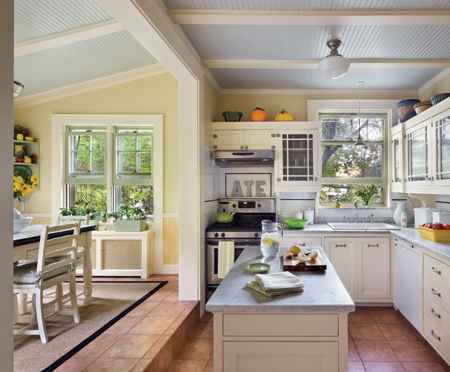
It was proof of a job well done when a visitor exclaimed, “Oh my gosh, you have my grandmother’s dream kitchen!” Here a three-phase renovation banished dark cabinets and orange and brown 1970s wallpaper in favor of a 1940s-style kitchen. The original cabinet boxes were retained, but transformed with white paint, new doors, trim and brackets. New wainscot, casing, an island, and appliances modernized the room – just enough. As storage was at a premium, Brewer designed a built-in pantry and a cabinet for wine glasses. “The kitchen was a complete disaster,” he says, “which was fortunate because a lot of people who looked at the house couldn’t see past that.”

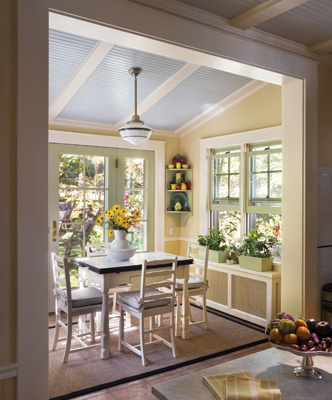
In place of tiny windows, a new door, windows and sidelites by Marvin Windows & Doors open the kitchen’s breakfast bay to the back yard. Stone retaining walls and landscaping provide privacy while the new bluestone patio, breakfast bay and grill spot around the corner provide several options for outdoor dining and coffee.

Upon purchasing the house, Brewer was presented with a fascinating record of its history and occupants. “I bought this house through Jane McAfee, a realtor and neighborhood advocate who owns a Victorian house in Park Hill,” he says. “When I moved in, she gave me a record that a long-time resident had collected of every house and who lived in it. I got this handwritten note card that listed all the families who had lived in my house, and there weren’t that many – just eight since 1906.”

“That’s what’s so interesting about houses,” Brewer adds. “Every house has a story, no matter where.” After 10 years, the architect has no plans to add another chapter. “I finally feel like it’s completely done. Now it’s time to enjoy it.”

Gary Brewer, a partner at Robert A.M. Stern Architects, recently completed a 10-year restoration and renovation project at his 1906 American Foursquare in the Park Hill neighborhood of Yonkers, NY. The neighborhood will feature in RAMSA’s upcoming book, Paradise Planned: The Garden Suburb and the Modern City to be published by The Monacelli Press this fall. Photo: © Francis Dzikowski / Esto

Gary Brewer, a partner at Robert A.M. Stern Architects, recently completed a 10-year restoration and renovation project at his 1906 American Foursquare in the Park Hill neighborhood of Yonkers, NY. The neighborhood will feature in RAMSA’s upcoming book, Paradise Planned: The Garden Suburb and the Modern City to be published by The Monacelli Press this fall. Photo: © Francis Dzikowski / Esto

To lighten the atmosphere of the ground-floor entry, Brewer, working with interior sytlist Brice Gaillard, replaced missing beams, painted the woodwork and chose a Farrow & Ball painting scheme that highlights the original features. Photo: © Francis Dzikowski / Esto

To lighten the atmosphere of the ground-floor entry, Brewer, working with interior sytlist Brice Gaillard, replaced missing beams, painted the woodwork and chose a Farrow & Ball painting scheme that highlights the original features. Photo: © Francis Dzikowski / Esto

The living room features new custom brick tile from Waterworks and a Brewer-designed wood mantel and over-mantel. The original ceiling beams were painted to complement the new color scheme. Photo: © Francis Dzikowski / Esto

The living room features new custom brick tile from Waterworks and a Brewer-designed wood mantel and over-mantel. The original ceiling beams were painted to complement the new color scheme. Photo: © Francis Dzikowski / Esto

Brewer replaced the dining room’s existing piano window, and installed new beams, wainscot, and light fixtures from Rejuvenation. He also designed a new built-in buffet in which to store his collection of antique English transfer ware. Photo: © Francis Dzikowski / Esto

Brewer replaced the dining room’s existing piano window, and installed new beams, wainscot, and light fixtures from Rejuvenation. He also designed a new built-in buffet in which to store his collection of antique English transfer ware. Photo: © Francis Dzikowski / Esto

By removing a wall and centering the door, Brewer created a large bedroom with windows on three sides, and French doors that open to the balcony above the entry porch. Photo: © Francis Dzikowski / Esto

By removing a wall and centering the door, Brewer created a large bedroom with windows on three sides, and French doors that open to the balcony above the entry porch. Photo: © Francis Dzikowski / Esto

The study overlooks the porch and features new bookcases for Brewer’s large collection of books on architecture and interior design, as well as artifacts culled from antique stores and flea markets. Photo: © Francis Dzikowski / Esto

The study overlooks the porch and features new bookcases for Brewer’s large collection of books on architecture and interior design, as well as artifacts culled from antique stores and flea markets. Photo: © Francis Dzikowski / Esto

In three phases, the kitchen was transformed from busy 1970s to 1940s. Brewer retained the original cabinet boxes, which were painted white and fitted with new doors, trim and brackets. The wainscot, casing, island, built-in pantry and cabinet, and appliances are also new. Photo: © Francis Dzikowski / Esto

In three phases, the kitchen was transformed from busy 1970s to 1940s. Brewer retained the original cabinet boxes, which were painted white and fitted with new doors, trim and brackets. The wainscot, casing, island, built-in pantry and cabinet, and appliances are also new. Photo: © Francis Dzikowski / Esto

The breakfast bay’s tiny windows were replaced with a new door, windows and sidelites by Marvin Windows & Doors that open the space to the back yard and flood the entire kitchen with natural light. Photo: © Francis Dzikowski / Esto

The breakfast bay’s tiny windows were replaced with a new door, windows and sidelites by Marvin Windows & Doors that open the space to the back yard and flood the entire kitchen with natural light. Photo: © Francis Dzikowski / Esto

Classical Comments: The Diocletian Window (By Calder Loth – ICAA)

calder-loth-imgBy Calder Loth
Senior Architectural Historian for the Virginia Department of Historic Resources and a member of the
Institute of Classical Classical Architecture & Art‘s Advisory Council.

Courtesy of: the Institute of Classical Architecture & Art  blog.classicist.org/

Dedicated in 306 A.D., the Baths of Diocletian survive as Rome’s only relatively intact ancient bath structure. Its main space, the vast vaulted frigidarium,[i] was preserved by conversion to a church under the direction of Michelangelo in 1563-64.[ii] A distinctive feature of the frigidarium is the series of huge windows along the upper tier of its side walls. (Figure 1) The window form consists of a large semi-circular arch divided into three sections by two thick vertical mullions.[iii] Because of their association with this structure, windows in this configuration are termed Diocletian windows, but we also describe them as thermal windows from thermae, the Latin word for warm bath. The windows’ brick construction was originally veneered with stone moldings and decorations of which only fragments remain in situ. Nevertheless, the form appealed to Renaissance architects who popularized it through treatises and projects. As we see in the following survey, architects have interpreted and applied the Diocletian window in a variety of ways over the past four and a half centuries.

Figure-17

Figure 1. The Baths of Diocletian, Rome (Loth)

Figure-21

Figure 2. Villa Foscari, Italy (Loth)

Andrea Palladio undertook detailed studies of Roman bath ruins with the intention of producing a book on the subject. His project never materialized but various features observed in the ruins found their way into several of Palladio’s designs.[iv] The Diocletian window appears in three of Palladio’s villa elevations published in Book II of I Quattro Libri (1570). Perhaps Palladio’s most prominent Diocletian window dominates the rear elevation of the ca. 1560 Villa Foscari, also known as La Malcontenta. (Figure 2) We have no published drawing of the rear; Palladio’s treatise illustrates only the villa’s portioced façade. Nevertheless, like the ancient prototype, the villa’s huge window is reduced to essentials. Its only ornament is the rustication joints scribed into the stucco.

Figure-31

Figure 3. San Moisè, Venice (Loth)

Palladio set a precedent for incorporating a Diocletian window into the façades of Venetian churches with his designs for San Francesco della Vigna (1566-70) and S. Maria della Presentazione, also known as Le Zitelle, (1577-80).  Palladio also incorporated Diocletian windows in the clerestory of Il Redentore (consecrated 1592). The tradition extended to several later Venetian churches including the façade added in 1688 by Alessandro Tremignon to the church of San Moisè, perhaps the most luscious Baroque façade in Venice. (Figure 3) Though hardly small, the Diocletian window above the entrance is almost overwhelmed by its Baroque encrustations. The window itself is set well back from the heavily decorated arch and mullions. With its sculptures by Heinrich Meyring, the façade is a monument to the Fini family, its patrons.

Figure-41

Figure 4. Gibbs Building, King’s College Cambridge: James Gibbs, A Book of Architecture (1728), plate 34.

In 1724, architect James Gibbs received the commission to design a complex of buildings for the front court of King’s College, Cambridge. Of the three massive structures in Gibbs’s scheme only the West Range, built 1724-31, was realized. For the central pavilions of each front, Gibbs proposed a broad Diocletian window atop a Doric aedicule framing the entrance arch. (Figure 4) This composition closely followed Palladio’s final design for the Villa Pisani at Bagnolo shown in Book II of I Quattro Libri.[v] As illustrated in Gibbs’s A Book of Architecture (1728), Gibbs intended the pediment slopes of the King’s building to be adorned with statues of reclining scholars in the manner of the figures on Michelangelo’s Medici tombs. The sculptures were never realized. Gibbs proposed a similar combination Diocletian window and portico for Whitton Place, Middlesex, but his design was rejected in favor of a design by Roger Morris.[vi]

Figure-51

Figure 5. Chiswick, London (Loth)

Richard Boyle, 3rd Earl of Burlington, was the primary leader of England’s 18th-century Anglo-Palladian movement. His passion for the architecture of Andrea Palladio and his contemporaries inspired his design for his villa at Chiswick. (Figure 5) Completed in 1729, the compact structure exhibited in its forms and details Lord Burlington’s broad knowledge of Palladian architecture. Burlington crowned his house with an octagonal dome prominently fitted with Diocletian windows on its four main faces. The use of this motif was likely inspired by one of Palladio’s early schemes for the Villa Pisani at Bagnolo, the drawing for which was among Burlington’s large collection of original Palladian drawings. (Figure 6) The stair and inset Palladian window in the drawing are features also reflected in Chiswick.

Figure-61

Figure 6. Andrea Palladio, Preliminary design for the Villa Pisani at Bagnolo; pen and brown ink drawing, ca. 1542. (Royal Institute of British Architects)

Figure-71

Figure 7. Mount Clare, Baltimore (Loth)

The lunette in the pediment of Baltimore’s Mount Clare is among America’s very rare Colonial-era versions of the Diocletian window. (Figure 7) Unlike the more standard half-circle examples, Mount Clare’s window is a shallow segment supported with the requisite pair of vertical mullions to give it the thermal form. The voids between the mullions are backed with small window panes. Mount Clare was erected in 1760 as a villa with an extensive park and terraced garden for Charles Carroll, a prominent Maryland patriot. As seen in the illustration, the house walls are laid in header bond, a characteristic feature of the finest colonial Maryland dwellings.

Figure-81

Figure 8. Faneuil Hall, Boston (Loth)

The Diocletian window enjoyed increased though limited popularity during the Early Republic. Boston architect Charles Bulfinch installed them in a handful of his buildings, including his 1805 expansion of the 1742 Faneuil Hall in the heart of Boston. (Figure 8) Bulfinch’s remodeling  involved increasing the original three-bay façade to seven bays and adding the tall third story. To accent the resulting vast pediment, Bulfinch inserted a Diocletian window flanked by two circular windows. Bulfinch gave prominence to the somewhat diminutive Diocletian window by framing it in a broad curved architrave, a trick he used in other designs and one that works effectively in this prodigious structure.

Figure-91

Figure 9. Former Bourse, St. Petersburg, Russia (Loth)

Architect Thomas de Thomon used the Diocletian window with dramatic flair in the attic gable of the St. Petersburg Bourse (Stock Exchange), a monumental landmark on the prow of Vlasilyevsky’s Island, across the Neva from the Winter Palace. (Figure 9) A multiplicity of thin voussoirs forming the arch gives the window the effect of a radiant sun rising from the portico. Partly hiding it, however, is S. Sukhanov’s sculpture group of Neptune with Two Rivers.  Surrounding the building is a peristyle of forty-two unfluted Greek Doric columns, an echo of Paestum. The strategically sited structure served as the center of financial and trade operations for Imperial Russia. Since 1940, the building has housed the Central Naval Museum.
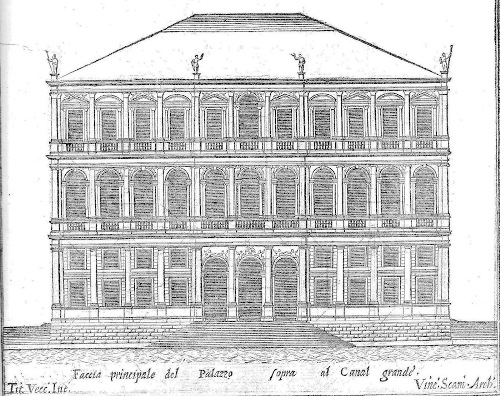
Figure-101

Figure 10. Imperial Stables and Carriage House, Pushkin, Russia (Loth)

We see a more lighthearted use of Diocletian windows on the Imperial stables in Pushkin (formerly Tsarskoye Selo), the suburban town of palaces and parks south of St. Petersburg. (Figure 10) Rendered in Russia’s virile Neoclassical style, the 1820 stable complex was designed by Vasily Stasov and Smaragd Shustov. Here a series of windows punctuates the façade of the stable courtyard. Setting off each window is a thick, plain lintel painted white to contrast with the tan stucco. The curved lintels reflect the semi-circular plan of the courtyard. The battered doorway and keystone focus attention on the center window. Vasily Stasov is best known as the architect of the Winter Palace staterooms, rebuilt after the fire of 1837.

Figure-111

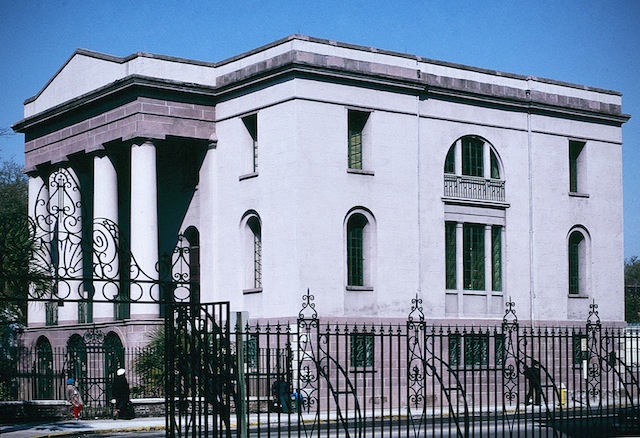
Figure 11. Fireproof Building, Charleston, South Carolina (Loth)

Architect Robert Mills incorporated a Diocletian window in the Meeting Street elevation of the Fireproof Building, constructed 1820-27 as a state office building. (Figure 11) It quickly became known as the Fireproof Building because of its pioneering use of non-combustible materials to protect government records. Though he was a dedicated classicist, Mills used the Diocletian motif in only a few instances. His mentor, Thomas Jefferson, interestingly, applied the motif to none his buildings. In the Fireproof Building, Mills tied the window into a composition embracing the three-part window below. Accenting it is a decorative iron railing, giving a lightness to an otherwise visually solid structure.

Figure-121

Figure 12. Low Memorial Library, Columbia University, New York City (Loth)

The firm of McKim, Mead & White made use of the Diocletian window in a variety of forms in numerous projects. In two of the firm’s most monumental works: Pennsylvania Station (1906-10; demolished 1964) and Columbia University’s Low Memorial Library (1893-95), the widows were of such huge scale that they were divided by four vertical mullions rather than the more standard two. (Figure 12) The use of four mullions at Low Library may have been dictated by the fact that the mullions are metal rather than thick masonry.  Nevertheless, with the window panes set in Roman lattice, the broad composition has a gracefulness despite its size.

Figure-131

Figure 13. Bavarian State Chancellery, Munich, Germany (Loth)

The heavy classicism of Imperial Germany, known as the Wilhelmine style, is boldly exhibited in the central domed section of what is now the Bavarian State Chancellery in Munich. (Figure 13) At the base of the dome is a pedimented pavilion framing a rusticated Diocletian window, a weighty contrast to the window in the Natural History Museum shown below. Designed by Ludwig Mellinger, the building’s center section is all that remained of the 1905 Bavarian Army Museum following the Allied bombing in World War II.  The destroyed wings were rebuilt in 1992 in glassy greenhouse style to house the state legislature and government offices.

Figure-141

Figure 14. Museum of Natural History, Washington, D.C. (Loth)

The firm of Hornblower and Marshall provided our National Mall with a classic Diocletian window set in the open tympanum pediment of the Natural History Museum, built 1901-11. (Figure 14) The allusion to classical Antiquity is reinforced by the use of bronze Roman lattice in the openings. Executed in white granite, the window’s plain architrave frame and vertical mullions lend the composition a restrained monumentality. Below the window is a hexastyle colonnade employing the Corinthian order of the Temple of Castor and Pollux, the three columns of which survive in the Roman Forum. The museum’s pediment and window is one of four identically treated pediments providing buttressing for the dome of this monument of the American Renaissance.

Figure-151

Figure 15. Memorial Gymnasium, University of Virginia, Charlottesville (Loth)

The ancient Roman baths provided excellent precedents for enormous formal enclosures such as railroad stations and gymnasiums. We see this in the University of Virginia’s Memorial Gymnasium, whose form was inspired by the Baths of Diocletian. (Figure 15) Completed in 1924, the design was the product of an architectural commission with Fiske Kimball, founder of the university’s school of architecture, serving as supervising architect. As with the Diocletian bath’s frigidarium, Memorial Gymnasium’s side elevations are composed of a series of gables supporting huge Diocletian windows. The gymnasium’s brick construction reflects the brick walls of the Roman baths, stripped of their stone veneers.

Figure-161

Figure 16. Brooks Brothers Store, Beverly Hills, California (Loth)

[i] The frigidarium was the main space in the bath complex. It was so termed because it contained a series of pools for cold baths.
[ii]
The church name is the Basilica of Santa Maria degli Angeli e dei Martiri. It was further embellished by architect Luigi Vanvitelli in 1749.
[iii]
The bottoms of the arches, where the curve meets the lintel, have been infilled with masonry for extra support, giving the arch a slightly stilted look.
[iv]
Palladio’s drawings of the baths were eventually published by Lord Burlington in 1730, and by Charles Cameron in 1772.
[v]
The portico proposed for the Villa Pisani was not built but the Diocletian window is intact.
[vi]
Terry Friedman, James Gibbs (Yale University Press, 1984), p. 317.

Byrd Residence Restoration Project

Chadsworth’s 1-800-COLUMNS is honored to have provided the Ionic columns for the restoration of the 1920’s Colonial Revival home — the Byrd Residence.

Located in Fort Worth, Texas, this project was tackled by renowned designers, Christine G. H. Franck & Brent Hull.
This renovation project, along with the respective designers, were honored with the Historic Fort Worth award for Excellence in Preservation and a John Staub Award from The Institute of Classical Architecture & Art, Texas Chapter.

Read more about the project, and see Before & After photographs here:

READ MORE HERE

Byrd Residence Renovation

Byrd Residence Renovation

Byrd Residence Renovation

Byrd Residence Renovation

Classical Comments: Alternating Pediments (By Calder Loth – ICAA)

calder-loth-imgBy Calder Loth
Senior Architectural Historian for the Virginia Department of Historic Resources and a member of the
Institute of Classical Classical Architecture & Art‘s Advisory Council.

Courtesy of: the Institute of Classical Architecture & Art  blog.classicist.org/

A perusal of classical facades from ancient times to modern reveals a persistent use of alternating triangular and segmental pediments for topping openings and other architectural features. What is the rationale for this convention? Written discussion of alternating pediments is almost non-existent, thus we might surmise that it was an innately understood device for instilling an interesting visual rhythm to a series of bays or openings. A row of continuous triangular pediments is visually static. Alternating triangular pediments with curved-top ones provides visual lilt and encourages the eye to skip from one end of a facade to the other. Even when a structure has only three bays, alternating their pediment shapes makes a facade livelier than if all three pediments were treated the same.

photo-1

Figure 1. Temple of Vespasian, Pompeii (Loth)

The courtyard of the Temple to Vespasian in the ruins of Pompeii offers a telling image of the ancient Roman application of alternating triangular and segmental pediments.[i] (Figure 1) Constructed after the earthquake of 62 AD, the bare brick pediments and frames of these blind openings likely served as foundations onto which more fully modeled stuccoed moldings and other ornaments were applied. Such decorative enhancement would have been obliterated in the fallout from the eruption of Vesuvius in 79 AD. Nevertheless, the denuded elements provide us with an early ancient use of this treatment for pediments. The architectural remains at Pompeii would have been unknown to Renaissance architects since systematic excavations and study of Pompeii were not undertaken until the 18th century.

photo-2

Figure 2. Great Court side wall, Baalbek, Lebanon (Loth)

Constructed during the reign of the Emperor Trajan, the Great Court of the Temple of Jupiter in the magnificent ruins of Baalbek also preserve examples of alternating pediments. The court’s side walls are embellished with aedicules that presumably held images of deities. (Figure 2) The figures are long gone as are the columns that provided visual support for the surviving pediments. Anchored to the wall, the remaining alternating pediments are sophisticated works of Roman design. Each of the pediments breaks in the middle, with the center portion of each being recessed. Such details may have provided inspiration for Georgian-period designs through Robert Wood’s richly illustrated Ruins of Balbec, Otherwise Heliopolis in Coelosyria (1757).

photo-3

Figure 3. “Temple of Jupiter,” I Quattro Libri, (Tavenor & Schofield Translation, 2002) Book IV, p. 43.

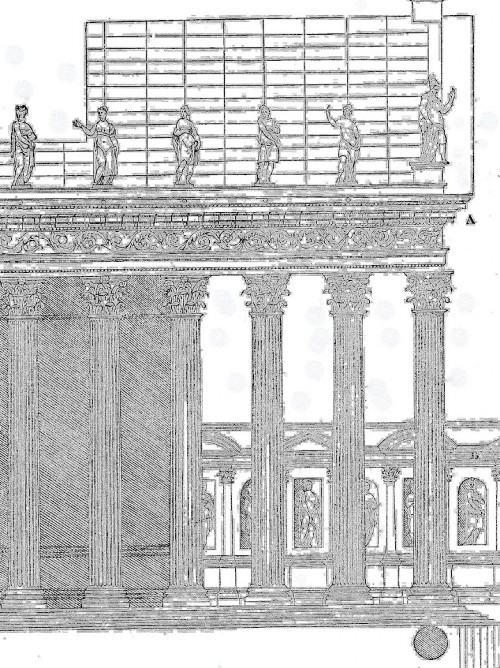
Andrea Palladio’s Book IV of I Quattro Libri dell’Architettura (1570) is filled with Palladio’s conjectural reconstruction drawings of Roman temples, an invaluable record of many structures that have since been lost. Although alternating triangular and segmental pediments became a standard treatment for openings on many Renaissance buildings, few examples are shown in Quattro Libri’s Book IV, and indeed few if any ancient examples survive in Rome. However, we see aedicules with alternating pediments on the courtyard walls of Palladio’s reconstruction drawings in Book IV of what he named the Temple of Jupiter. Scholars have now identified this temple as the Temple of Serapis, built by the Emperor Caracalla on the Quirinale Hill.[ii] (Figure 3) The ruins were destroyed in 1615; we know the temple and its pediments only through Palladio’s images.

photo-4

Figure 4. Palazzo Chiericati, Vicenza, Italy (Loth)

Palladio applied alternating pediments in several of his own works including the Palazzo Civena, the Palazzo Thiene, the Palazzo da Porto, the Palazzo Barbarano, the Palazzo Porto-Breganze, and the Teatro Olimpico, all in Vicenza. He undoubtedly learned the device through his detailed study of Roman ruins, such as the temple discussed above, as well as through his observations of works of other Renaissance architects. What is perhaps Palladio’s most conspicuous and elegant application of alternating pediments highlights the center section of Vicenza’s Palazzo Chiericati, begun in 1551 and completed in stages. (Figure 4) Here Palladio placed reclining figures on each slope of the pediments, recalling Michelangelo’s use of such figures albeit more emphatic ones, on the Medici tombs. Palladio installed similar lounging figures on the pediments of the Palazzo Barbarano.

photo-5

Figure 5. Design for Palazzo Cornaro, The Idea of a Universal Architecture (Architectura & Natura Press, edition, 2003) Vol . III, p. 87 (detail)

Palladio’s protégé, Vincenzo Scamozzi, continued his mentor’s tradition of alternating pediments in his designs for buildings both in Vicenza and Venice. Many of these projects, built and unbuilt, were published in Scamozzi’s treatise, L’Idea della Architettura Universale (1615). One of his more ambitious schemes was for a prodigious palace for Cardinal Federico Cornaro on Venice’s Grand Canal. (Figure 5) Scamozzi’s published elevation in L’Idea displays the top-floor windows framed by aedicules with alternating pediments. As with the Palazzo Chiericati, several of the pediments sport reclining figures. Although the construction of Cardinal Coronaro’s palace never commenced, the design for this and other works in the treatise subsequently influenced architects elsewhere in Europe, especially the Netherlands and Britain.

photo-6

Figure 6. Banqueting House, Whitehall, London (Loth)

Inigo Jones is credited with introducing Palladio’s and Scamozzi’s versions of the Italian Renaissance mode to Britain. Jones traveled in Italy in 1612-13 where he visited many of Palladio’s buildings and met Scamozzi. He also acquired a copy of Scamozzi’s L’Idea della Architettura Universale.[iii] Jones was appointed Surveyor of the King’s Works in 1615, in which capacity he built several important royal commissions including the Banqueting House at Whitehall Palace in 1619-22. (Figure 6) With its unadulterated Italian character, the Banqueting House launched the first phase of Britain’s Anglo-Palladian movement. Following the precedent of Palladio and Scamozzi, Jones treated the windows of the Banqueting House main level with alternating pediments, some of the first of many to come throughout Britain.

photo-7

Figure 7. Senate House, Cambridge University (Loth)

Architect James Gibbs was one of Britain’s most influential 18th-century practitioners of the Anglo-Palladian style. Gibbs popularized Palladio’s classical mode not only with his many finely composed buildings but through his two publications: Book of Architecture (1728) and Rules for Drawing the Several Parts of Architecture (1732), both of which served as guides for architects and builders throughout the British Isles and the American colonies. A rich but well-modulated example of Gibbs’s works is the Senate House at Cambridge University, built 1721-30. (Figure 7) As in many of his designs, Gibbs employed alternating pediments for its windows. He departed from convention here by placing the pedimented windows on the ground level with arched windows above. This treatment was probably dictated by the fact that the building has no podium and its interior is a single large room. Hence there is no piano nobile as in more academic classical buildings.

photo-8

Figure 8. Drayton Hall, South Carolina (Loth)

photo-9

Figure 9. Plate 38, Designs of Inigo Jones with some Additional Designs

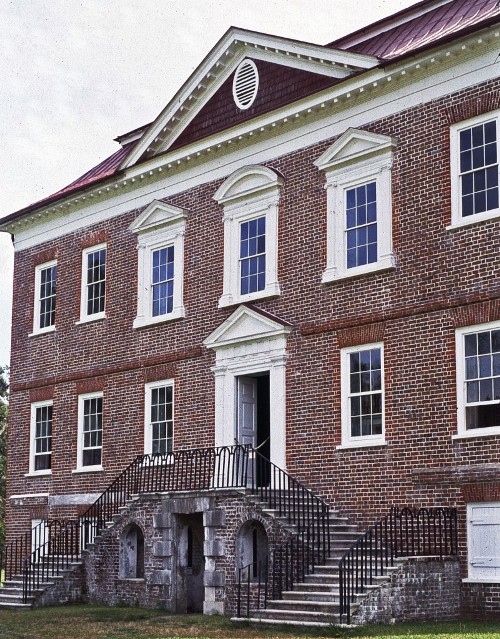
The three second-story windows in the river front of the ca. 1740 Drayton Hall may well be America’s earliest use of alternating pediments and aedicule window frames.[iv] (Figure 8) John Drayton, for whom Drayton Hall was built, owned several British design books, including Vitruvius Britannicus, which illustrates numerous country houses with alternating pediments. However, the use of just three bays with alternating pediments closely resembles a scheme on Plate 38 in Designs of Inigo Jones with some Additional Designs (1727), edited by William Kent. (Figure 9) John Drayton did not own this tome but an illustration for a chimneypiece in this book definitely served as the basis for the chimneypiece in Drayton Hall’s great hall. John Drayton, however, did own James Gibbs’s Book of Architecture (1728), which illustrates individual pedimented Ionic aedicules closely paralleling those at Drayton. While academically correct from a design standpoint, the three windows are somewhat awkwardly placed, particularly the center one, which perches precariously on the tip of pediment below.

photo-10

Figure 10. Southwest courtyard, Palace of Caserta, Caserta Italy (Loth)

When alternating pediments are employed on a multi-story building, it is usual to have only one level of openings so treated. Upper-level openings either have no pediments or have a row of windows with consistently triangular pediments as in Rome’s Palazzo Farnese. We can only speculate that the reason for this is that more than one level of alternating pediments would make for an overly busy composition. Caserta, the great country palace of the Kings of Naples, built 1752-1780, offers an exception. (Figure 10) The widows on the exterior elevations and in the four huge courtyards are enriched with alternating pediments on two levels. Architect Luigi Vanvitelli was clever enough to stagger the pediments so that the triangular and segmental pediments alternate vertically as well as horizontally. The lively treatment is countered by the palace’s gigantic scale. (Note the scale figure in the photograph.)

photo-11

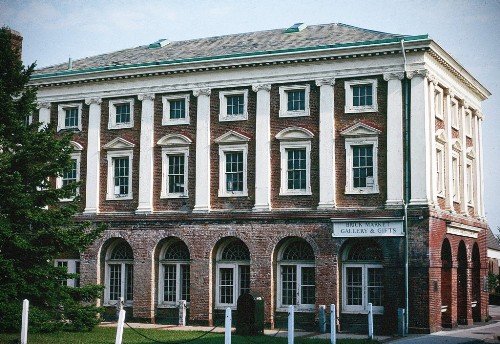
Figure 11. Brick Market, Newport, Rhode Island (Loth)

Among the most academic of our colonial-period structures is the 1762 Brick Market in Newport, Rhode Island designed by Peter Harrison, one of the earliest professional architects to work in America. The market’s main level is set off by windows with alternating pediments. (Figure 11) The windows are enhanced with pulvinated friezes and eared architraves. Architectural Historian William H. Pierson maintained that the market’s design was modeled after a now lost gallery of London’s Somerset House, a work attributed to Inigo Jones and illustrated in Colen Campbell’s Vitruvius Britannicus (Vol. 1, Plate 16, 1715). [v] Like the market, the Somerset House design has an arcaded ground floor with windows above framed by pilasters and topped with alternating pediments. Newport’s Brick Market may be the country’s only colonial-period public building to have alternating pediments.

photo-12

Figure 12. White House, Washington, D.C. (Loth)

America’s most famous display of alternating pediments is, of course, on the White House where the pediments highlight the first-floor windows on both the north and south fronts. (Figure 12) An outstanding example of the Anglo-Palladian style, the White House exhibits the influence of James Gibbs’s designs, but more directly was inspired by Leinster House, the Dublin mansion erected 1745-48 for the Duke of Leinster, and now seat of the Irish Parliament. Designed by Richard Cassels, Leinster House likewise has alternating pediments decorating its windows. James Hoban, architect of the White House, was an Irish native trained in Dublin, and was well acquainted with Leinster house.[vi] Hoban’s White House scheme won the design competition for the President’s House as it was the personal favorite of George Washington.[vii] Our twenty-dollar bills have offered millions of immediately accessible images of the White House and its pediments.

photo-13

Figure 13. Aile Napoleon, Louvre, Paris (Loth)

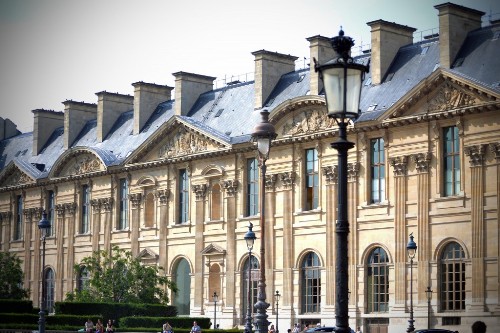
An arresting but frequently overlooked use of alternation pediments enlivens the Aile Napoleon (also the Galerie Nord), a wing of the Louvre, now housing the Musée des Arts Decoratifs. Following his becoming First Counsel in 1799, Napoleon determined to achieve the long-standing ambition to connect the Louvre with the north end of the Tuileries Palace, and commissioned architects Charles Percier and Pierre Fontaine to design the connector. For its south elevation, the architects chose to mirror the ca. 1600 facade of the Grand Galerie on the opposite side of the courtyard. Like the Grand Galerie, Percier and Fontaine’s facade was marked by an imposing progression of alternating triangular and segmental pedimented pavilions with each pediment supported on paired Composite pilasters. (Figure 13) The seven westernmost pavilions of the original thirteen sections of the Aile Napoleon were destroyed when the Tuileries was burned during the Commune of 1870, and were rebuilt to a different design. Moreover, the original Grand Galerie facade was lost in the 1860s when refaced with a different scheme by Hector-Martin Lefuel.

photo-14

Figure 14. Leuchtenberg Palace, Munich, Germany (Loth)

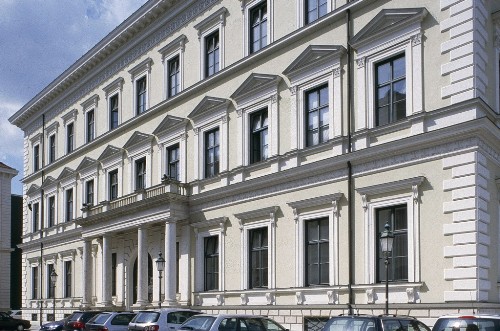
Leo von Klenze’s Leuchtenberg Palace in Munich is instructive for illustrating the effect created by avoiding alternating pediments. Although the palace is a dignified adaptation of the Renaissance mode, one inspired by the Palazzo Farnese and other Roman palaces, von Klenze shunned the time-tested device of alternating pediments for the palace’s middle level windows. (Figure 14) As a result, the continuous row of triangular pediments is monotonous. It gives the facade a static appearance instead of one with the lively rhythm that alternating pediments could provide. Nevertheless, von Klenze’s design launched the Neo-Renaissance movement in 19th-century Germany. The palace was completed in 1816 for Napoleon’s stepson, Eugene de Beauharnais, who married into the Bavarian royal family and was created Duke of Leuchtenberg.

photo-15

Figure 15. National Building Museum, Washington, D.C. (Loth)

Originally built as the Pension Building, Washington, D.C.’s National Building Museum, completed in 1887, is an awesome if not unique Victorian interpretation of the Italian Renaissance style. Army architect/engineer Montgomery Meigs took Rome’s Palazzo Farnese for inspiration but translated its form in bright red pressed brick and terra cotta, and gave it a facade of twenty-seven bays instead of the Farnese’s thirteen. (Figure 15) Nevertheless, Meigs was faithful to the model in his application of aedicules with alternating pediments for the mid-level windows. He strayed somewhat from the Farnese in his use of the Ionic order here instead of the Corinthian. Yet, true to his model, he maintained consistent triangular pediments for the top floor as did Michelangelo, who added the top story to Antonio da Sangallo’s lower two floors of the Farnese. Meigs’s alternating pediments indeed keep the eye bouncing down all twenty-seven bays.

photo-16

Figure 16. Otto Kahn Mansion, New York City (Loth)

Alternating triangular and segmental pediments appear infrequently on 20th-century American buildings. The firm of McKim, Mead & White illustrated only a handful of examples in the voluminous monograph of their works. We see scant use of alternating pediments in the buildings of such notables as Carrère & Hastings, John Russell Pope, and Horace Trumbauer. A notable exception to this trend is the fabled mansion of the banker and philanthropist Otto Kahn in the Carnegie Hill neighborhood of New York City. (Figure 16) Designed by the British architect J. Armstrong Stenhouse, with New York’s C.P.H. Gilbert as associate, the main elevations are modeled after the ca. 1500 Palazzo Cancelleria in Rome, which, interestingly, does not have pediments on its windows. The pediments on the Kahn mansion add visual relief to the otherwise seriously Renaissance-style edifice.

Alternating pediments are a useful device for any classical-style building and can enliven an otherwise sober elevation. We would hope to see them used from time to time on 21-century works. I am not aware of recent examples of alternating pediments would appreciate learning of any.


[i] The temple complex is believed to have been originally been dedicated to the Genius of Augustus.
[ii]
Andrea Palladio, The Four Books on Architecture, Translated by Robert Tavenor and Richard Schofield (MIT Press, 2002) p. 373.
[iii]
Patti Garvin, Koen Ottenheym, Wilbert Vroom, Vincenzo Scamozzi, The Idea of a Universal Architecture. Volume VI, (Architectura & Natura Press, Amsterdam, 2008), p. 26.
[iv]
I am indebted to Ralph Muldrow for making this observation.
[v]
William H. Pearson, Jr., American Architects and Their Builders; The Colonial and Neo-Classical Styles (Doubleday and Company, 1970) pp. 148-49.
[vi]
Hoban was trained in Dublin where he received the Duke of Leinster’s medal for drawing from the Dublin Society in 1780.
[vii]
Like Leinster House, the White House originally was built with an engaged Ionic portico on the north elevation. The present portico was added in 1829.

Take a look at our Decorative Pediments, Combinations, and additional Entryway Systems at:  http://shop.columns.com/decorative-home-and-commercial-entryways.aspx